Comfortable Being Uncomfortable: Michael Bauman on Happy Accidents
LOS ANGELES,
MARCH 2026
In the final stretch of the latest awards season, just days before the Oscars, Michael Bauman and I met in a café in Los Feliz to talk about the “visual jam” of his latest work. As cinematographer for Paul Thomas Anderson’s One Battle After Another (2025), he worked on a production that prioritized raw energy over traditional polish. Our conversation drifted through the hurdles of VistaVision to his experiences gaffing for the industry’s most respected names. Bauman reflects on everything from the “happy accidents” and improvisations that gave One Battle its unnerving life.
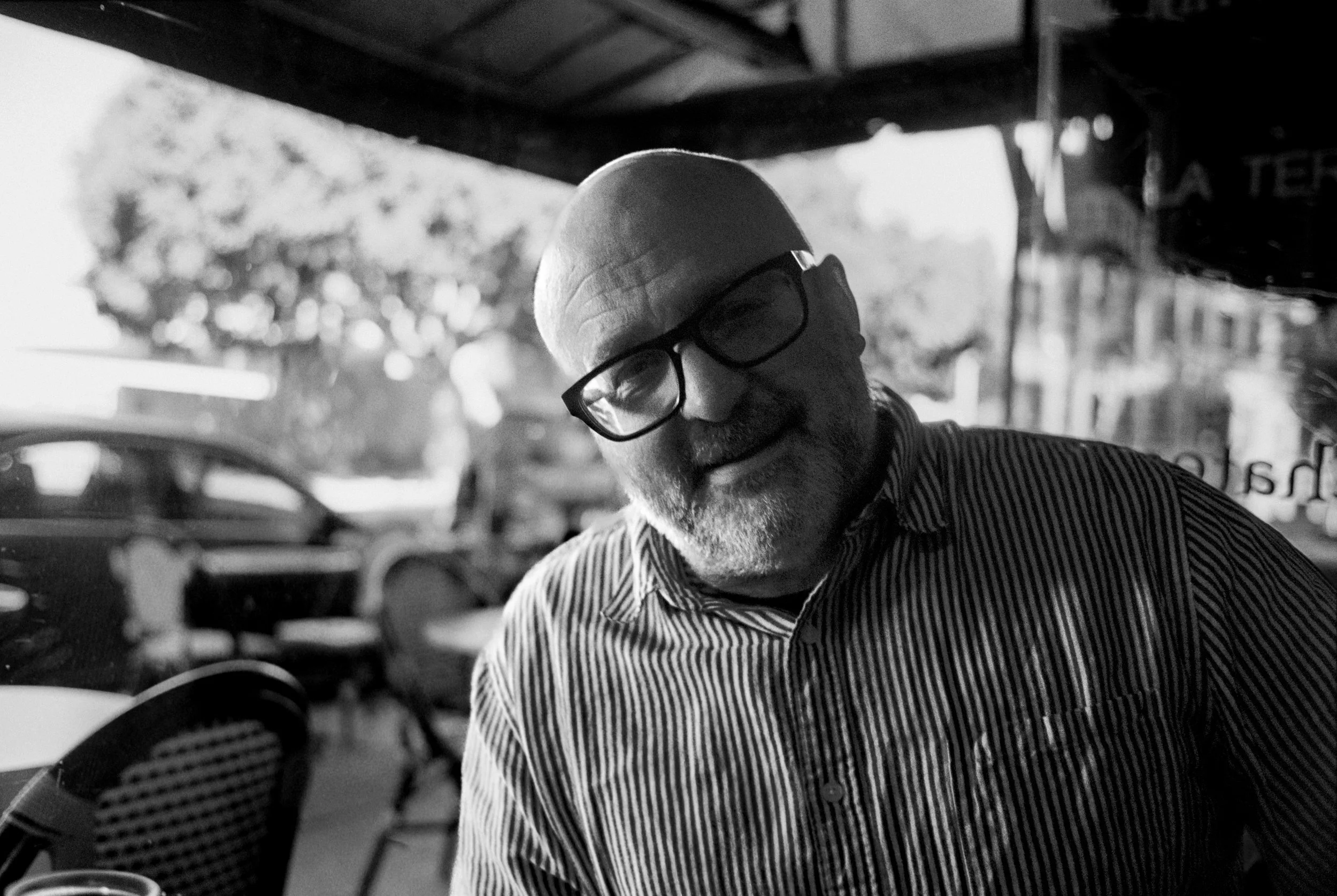
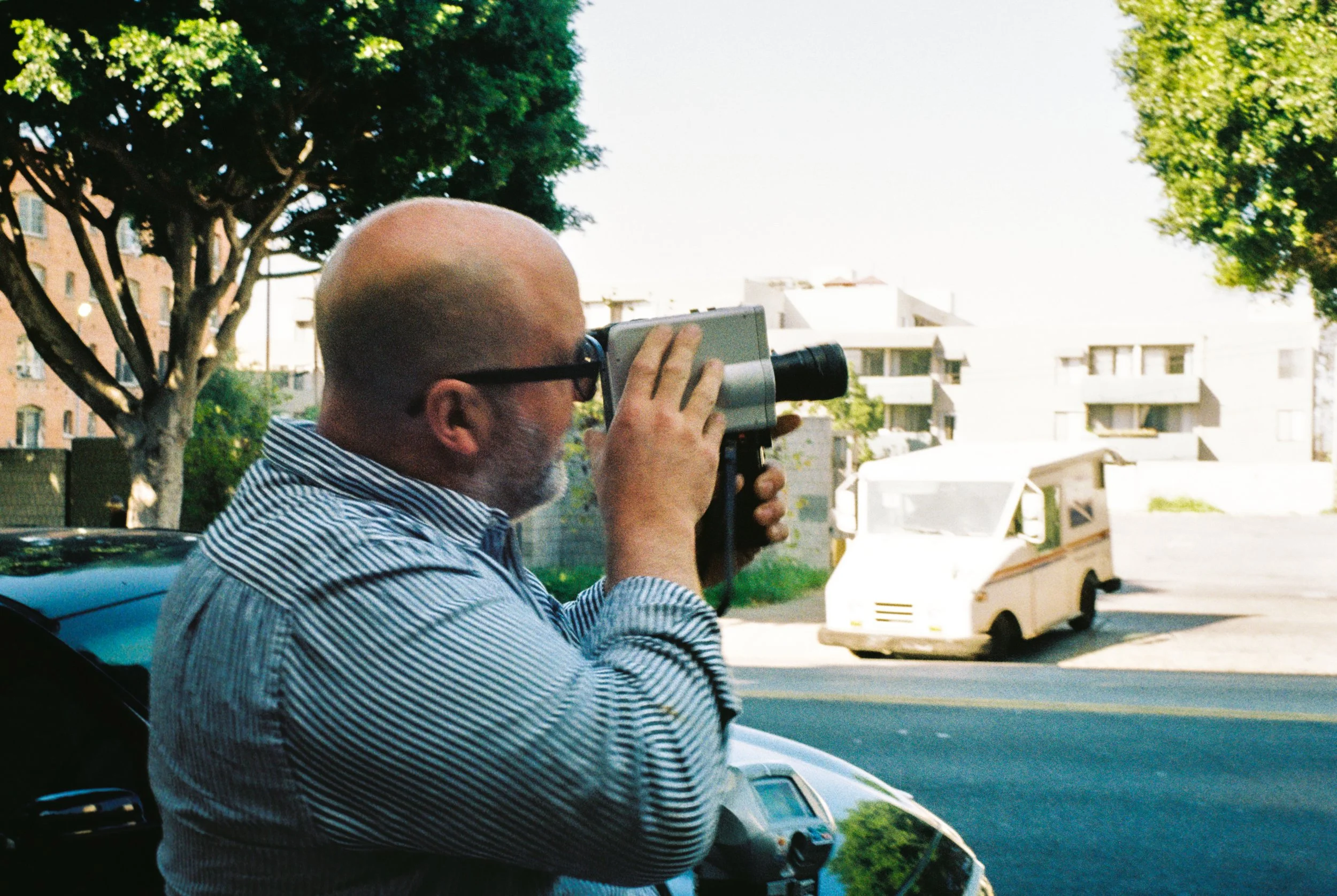
Micheal Bauman in Los Angeles
© Burcu Beaufort
Burcu Beaufort: What are the elements that can convince you to commit to a film?
Michael Bauman: A lot of times, it’s about an interesting story, but also interesting filmmakers, people you want to work with. Because you’re with somebody for so long, it’s like a marriage. Especially now with tax credits and incentives, we’re shooting everywhere but here in LA. So you’re mostly someplace else, and that can be difficult. Sometimes I’ll take a movie just because of the script, but other times I want to be in LA, or even in New York, and don’t necessarily want to be traveling overseas, because so much of production now is based on incentives.
The whole movie business has just changed so radically. It mostly used to be a self-sustaining industry over the last 30 years, especially the Hollywood studio pictures. Now, with the streaming model, everything is based on production costs.
Burcu Beaufort: Do you prefer shooting on location instead of studio or it just depends on the project?
Michael Bauman: I think it depends on the project, but generally, I think shooting in the practical locations is way better. In a place like this (café), you get the texture of the wall, the reflections, the way light behaves. If we were trying to make that happen in a studio, it's fun to do, it's just a different set of challenges. And sometimes with certain filmmakers, it's better to be in a practical location because they have to adhere to the rules of the space. Paul (Thomas Anderson), for example, he barely ever shoots on stage. It's very rare.
Burcu Beaufort: Do you think being on location actually adds to the performances, to your work, and ultimately to the film itself? And how much do you think luck plays a part?
Michael Bauman: It depends on the project, but I think it helps. You get happy accidents that happen, which can be very beneficial to the project.
Luck is just when those accidents happen. When you always get a group of people together, working on a project, very intensely, interesting things happen. I think it's important to grab those moments. On One Battle After Another, there were so many interesting things happening, you would be like, "Oh, my gosh. You gotta look at this."
Paul’s approach on certain movies, like on Phantom Thread (2017), was very deliberate and intentional. But One Battle was like... “Shit happens, and it can be good”. We had a group of actors who are incredible at improvising. There are so many moments in this film where some accidents happened and normally you’d be like, "Allright, cut, let's fix that." But this time, we just kept shooting. And the actors would play off with it.
Burcu Beaufort: For example?
Michael Bauman: Like when Leo (Di Caprio) is trying to make the phone call and trying to plug in his phone, while Sensei is introducing everybody to him. Then he finally gets the phone plugged in, and makes the phone call. As he goes into that room, he approaches the window, where there's a set of curtains. So they just fell. Leo never went like "I can't do this. Come on, guys, fix this." He just incorporated it into his performance and, because that was sort of fuel to his performance.
Burcu Beaufort: For a film with so much improvisation, how does VistaVision fit in?
Michael Bauman: We shot 80 plus percent of the movie on VistaVision and it definitely had its own requirements, you couldn't put that thing everywhere. This camera is designed to just sit on a stand and capture a beautiful forest or some sort of nice thing, but we were putting it on a Steadicam, using it as a handheld strapping it to cars.
A lot of times, we wanted to create a space so the actors could move around however. Paul didn't want a lot of trucks and all that stuff around. Sean Penn would just be in his Rivian pickup truck outside the set. He would be asleep with his feet up on the dash, and his assistant would be next to him doing emails in the front seat. Then they'd be like, "Hey, Sean, we need you." And he would go, you know "Allright, coming over."
Burcu Beaufort: Well this is perfect for the character he is playing.
Michael Bauman: Absolutely. Same with Leo. He usually has a team and a big trailer. Paul's like, "Look, we're not gonna make room for it because locations are so small." So Leo had a little Sprinter van. It was all about being able to shoot. Ultimately, it was a very small crew that would always be on set every day around the camera, which had an energy to it. That was kind of one of Paul’s tenets. Get rid of all what’s not strictly necessary, just let the performances and all the energy go. That was the whole key.
Burcu Beaufort: That chase scene in the movie is one of a kind. Tell me more about it.
Michael Bauman: Yeah, I think what really is successful about it is that it’s such a great combination of editing and the soundtrack. The visuals are one thing, and they’re absolutely a factor, especially in how Andy (Jurgensen) and Paul cut and put it together. Then there is Jonny Greenwood’s score, plus the sound design. It all works together.
All of Paul’s audio comes from what’s recorded on set. You don’t go back and think, “Oh, I need a different car, let me find something in a sound library.” Everything comes from the set. So the editorial team has to go through and pick all these different sounds from the cars since they all have distinct engine sounds. On top of that, the score with drums and all… It just adds so much tension and gives the film this really unnerving energy.
If you watch the sequence with the sound off, it becomes a completely different experience. It’s so interesting how those three elements came together so well.
Burcu Beaufort: How do you feel about your Oscar nomination for Best Cinematography?
Michael Bauman: I mean, when we were making it, it didn't feel like the cinematography was gonna be anything special. Some of the crew were like, "Oh, man, this is gonna get a lot of buzz about the cinematography," and I was like, "Dude, no way." Because everything's so extreme and so loose. Usually when you have such actors in a scene, you have so much control over it, the sun's not blasting them in the face. But in this movie, that was all part of the visuals. He gets hit in the face with the sun? Hell, yeah. And if it's completely overexposed? Absolutely.
With Paul, we do a lot of tests, maybe around fifteen or sixteen. That’s where you kind of really start to develop the visual language and see what everyone's comfortable with, because not every actor is comfortable with that kind of harsh lighting. But Leo was like, "Let's do it." That was part of the whole thing. Also when we did Sean Penn’s close-up where he yells at Willa (Chase Infiniti), I was hitting him with a raw light right in the face. It’s very harsh, but it works so well with the character he is playing.
Burcu Beaufort: What do you look for when you say a cinematography is truly beautiful?
Michael Bauman: It’s about how cinematography serves the story. I also appreciate people who can make something out of nothing. I gaffed a movie called Nightcrawler (2014 by Dan Gilroy) about 10 years ago. We didn’t have much money and only about 24 days to make the movie, most of it at night. Robert Elswit was shooting it. I’d just done a much larger movie with him, and he wasn’t as happy on that one as he was on Nightcrawler. There was joy, and he was really inspired by the imagery, even with a quarter of the resources. I’m sure he wasn’t even making that much as his pay. That was an eye-opener. Ultimately, as a cinematographer or any artist, you have to work on projects that are creatively challenging and make you happy.
Burcu Beaufort: For you personally, is it a kind of risk taking? Were you comfortable with that bigger tolerance to risk and accidents?
Michael Bauman: You had to be very comfortable being uncomfortable. It was a headspace that I had to get into. Generally, I knew we were getting good stuff, really interesting stuff, even if I was at times really unsure of how good it was gonna be exposure-wise. The other thing is, I didn't see dailies, because we were in so many different remote locations all over California. It could be three or four days before you saw what you shot.
Burcu Beaufort: Any scenes with challenging lighting situations that turned out well?
Michael Bauman: (Looking at the scene that is shot indoors with Bob (Leonardo DiCaprio) and Perfidia’s (Teyana Taylor) talking about their relationship and their baby, signs of Perfidia’s postpartum depression) When I did this scene, it was a hard day for me. When we shot it, I thought I should have put a bit more light on her face. But it worked. We didn’t know what she was going to do, but I knew there would be a lot going on in her expression. So we had some lights hidden here and there. We did this scene maybe eight times and Teyana just kept getting better and better.
Burcu Beaufort: How about fixing the exposure in the post production?
Michael Bauman: Normally you scan, and you have access to all the digital tools. But since Paul wanted to release it on film, cutting the negative, you don't have any of that. For the post production, we have just a very basic set of tools and one change affects the entire image. You can't just go in and be, like, "All right, I just want to darken the sky, keep the faces." No.
Burcu Beaufort: You’ve had a long working relationship with Paul Thomas Anderson. Does that make this kind of risk-taking easier?
Michael Bauman: Yeah, we’ve developed a bit of a shorthand. Paul and I have done enough films to reference past scenes and pull ideas from them.
But he constantly challenges you, asking why you’re doing something, and you need to explain. If we were shooting a scene here, he’d question every detail of the setup, the glasses, the table. His fingerprints are on everything. That’s just part of his process.
He asks the actors to go to a similar place. On Phantom Thread, Daniel Day-Lewis sat with the set decorator and production designer, going over every detail of a breakfast table. Véronique Melery had a story for almost every object, so that Daniel could pull those little nuggets into the performance.
Burcu Beaufort: The film is also nominated for Best Casting, is there any interesting anecdote you want to share? (Our interviews dates back to March 11th, before the Oscars where One Battle won the Oscar for Best Casting)
Michael Bauman: Cassandra Kulukundis, who’s done casting for most of Paul’s films, has also cast many non-actors. There's so many people in this film who have never acted before. Like, the “vato” skateboarders were all local (Gilberto Martinez Jr., Luis Trejo, Elijah Joseph Sambrano, and Julian Corral).
The guy holding Willa under arrest was actually the driver of the truck carrying all the picture cars. A few days earlier, Paul said, "I think I want to cast him," but the driver was nervous about being in the film.
He ended up having a scene with Avanti (Eric Schweig), but he didn’t feel comfortable saying racist lines to him, even in character. Eric pulled him aside and said, "Look, I’ll tell you what you can say. Call me this. Call me this. Call me this, too. Let’s practice it," just to help him get comfortable. That was pretty crazy.
After the scene where he gets shot, he’s covered in blood and has to take a shower, then go back to loading the cars and driving the truck to L.A. the same day. The whole thing was kind of crazy. But that’s the kind of energy Paul was going for.
Also, the kid who comes to the door to pick up Willa, I don’t think he was an actor. They needed cars since we were up in Eureka, and he was one of the locals who showed up with his car and ended up being cast.
Burcu Beaufort: How did you end up with filmmaking?
Michael Bauman: In college, I started working on 16mm and thought it was interesting. I applied to a few film schools and got into AFI, just for one year. I didn’t finish the program because it was a tremendous amount of money. It's even more expensive now. Every weekend there were projects. You studied in class, but mostly you built your skill set by constantly shooting. That’s where I met people like Darren Aronofsky, Todd Field, Scott Silver, Matthew Libatique, and others who went on to be successful directors and writers. During that time, music videos were massive. They all shot on film, and they all had budgets. We did so many rap videos, Death Row Records, Snoop, Tupac, all that stuff. We were constantly shooting and also learning how to light people with different skin tones and qualities.
There are so many things, you show up and you’re like, okay, we’ve got to make this look cool. That went on like for three, four years, just bam, bam, bam.
They were mostly short projects. You work two days, then maybe have a couple of days off, then do another one. So we were working so much, it really helped build a base of understanding, like how to expose film and all that. I kept working as a gaffer, working with my friends, and that led to other stuff. That’s kind of how it got going.
Burcu Beaufort: You didn't start out as a cinematographer, and actually worked for other great cinematographers as gaffer. How does this experience impact your work now?
Michael Bauman: It was one of the luxuries I had. I spent over 20 years as a gaffer, working with amazing cinematographers and seeing how each has a different approach and style, from Bruno Delbonnel, Emmanuel “Chivo” Lubezki, Matthew Libatique, Janusz Kamiński, and others. It was fascinating to see how they think, approach problems, and where their choices come from. It’s also interesting comparing the American process with the European one. I remember working with Paweł Edelman on Ray (2004 by Taylor Hackford) in New Orleans. His approach was very naturalistic, and watching that up close was very interesting. I feel very fortunate to have come from that side, just to soak in all those experiences,
Also, working with cinematographers who are at a point in their lives where they’re completely comfortable in their work. I experienced that with Harris Savides on The Bling Ring (2013), directed by Sofia Coppola. At the time, Harris had a brain tumor. He knew he was sick, and they were treating it. It ended up being his last film. On the set, he just wanted to try things. He was like, “let’s try something else, and if it doesn’t work, blame me. I don’t care.” It was so liberating to hear somebody who was just approaching it that way.
Burcu Beaufort: Do you feel that there is an artistic side to being a cinematographer?
Michael Bauman: There are people who operate more from the artistic side, and others who operate more from the technical side. I think it’s about finding that balance. At the end of the day, you have to figure out how you’re going to make the day, like, we’ve got to get this scene done today.
So it’s great that you want to do all that, and want to spend five hours getting something perfect. But then the director’s like, “I’ve got two hours to shoot the scene and 10 pages of dialogue.” No bueno. So you really have to be in concert with the team.
Burcu Beaufort: How’s your approach?
I always have a plan, at least for me, even if I don't use the plan. It just structures my brain. In filmmaking, someone’s always got to take the first step; like in jazz, someone has to play the first note. Sometimes you bounce a light off the floor, and it doesn’t feel right, so you try something else. Everyone’s creative engine works differently.
It’s like a visual jam, not everyone works with rigid setups. Some people plan every shot down to the lens they are gonna use, while others just bring the actors in and capture the energy as it comes. Both approaches are beautiful. There’s no wrong way to do it.
Burcu Beaufort: Outside of filmmaking, are you working on any other creative projects?
Michael Bauman: Yeah, I'm a musician. I put myself through college playing in a bar band. Mostly keyboards. That's actually how I got to start working with Wally Pfister, because Wally Pfister loves playing guitar. When I was working with him, he was like, "Oh, you play?" And so we ended up at his house playing music, it was just fun.
Burcu Beaufort: Last question, the classic: Do you have a preference for shooting on film or digital?
Michael Bauman: I remember in AFI, we had a lot of cinematographers come in to talk to us, amazing people. John A. Alonzo was there; he shot Chinatown (1974), Norma Rae (1979), Scarface (1983); Owen Roizman was there, who shot The French Connection (1971) and The Exorcist (1973), and many others from a generation of Hollywood whose work has truly stood the test of time.
One of the guys who came in was Conrad Hall. He was the pinnacle of cinematography. Super laid back, with a resume including In Cold Blood (1967) and countless iconic films. People were complaining about shooting on videotape, and he said something that still resonates today: it doesn’t matter what you shoot on. You could shoot on a kid’s Fisher-Price camera. If you’re telling the story through images, that’s what counts. It’s not the medium, it’s the storytelling.
That idea is liberating. There are no rules, as long as you’re trying to tell the story in the strongest way. It doesn’t matter if it’s film, digital, or some format we don’t even know about. I saw an old movie from the ’90s, Laws of Gravity (1992) by Nick Gomez. They had no money and ran out of film. Parts of the movie go black, and you just hear the actors talking. They turned a limitation into storytelling, almost like chapters. It’s inspiring to see that kind of creativity.