Daisy Edgar-Jones and Esmé Creed-Miles on Sense and Sensibility
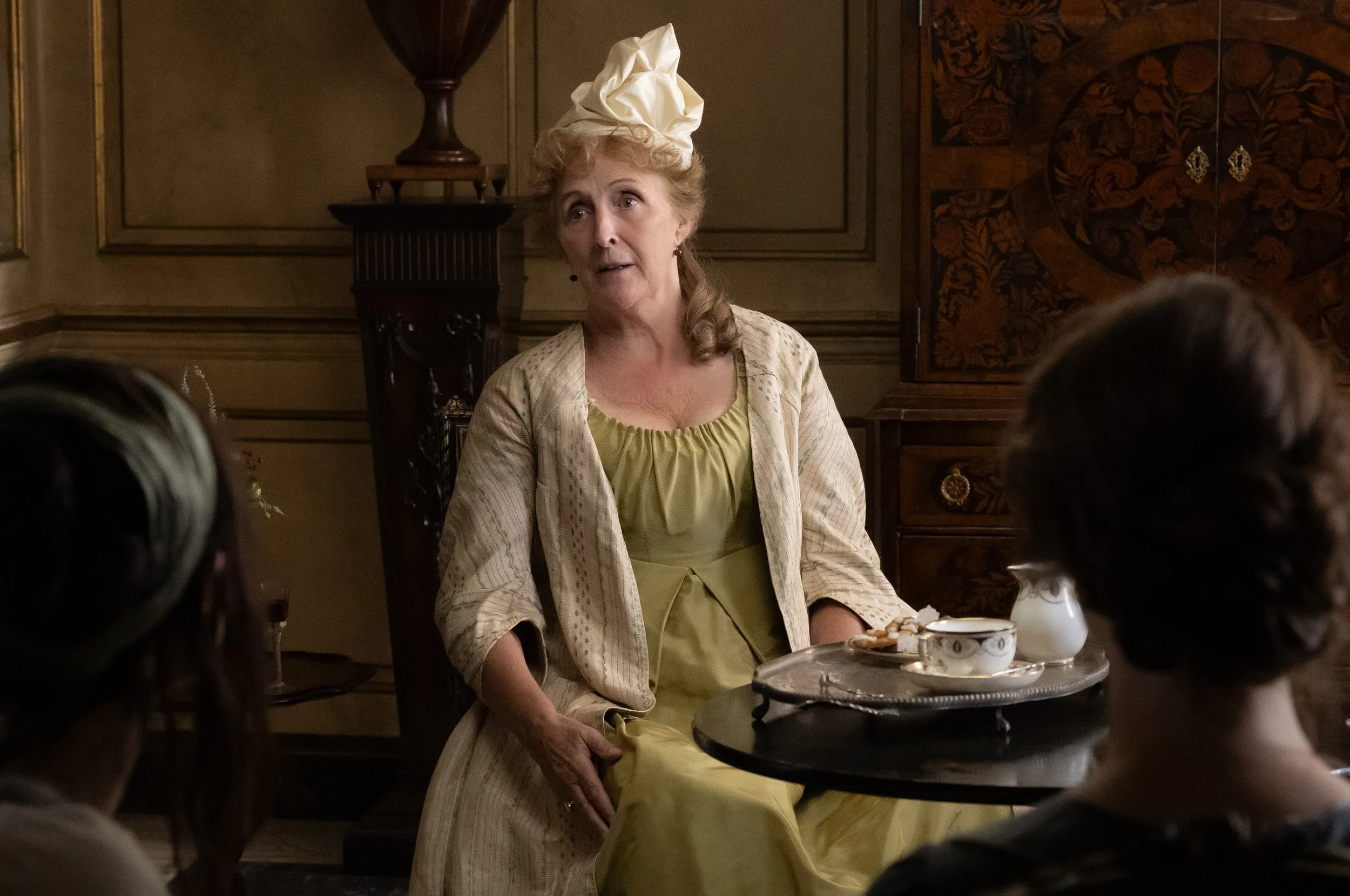
Georgia Oakley’s Sense and Sensibility, starring Daisy Edgar-Jones and Esmé Creed-Miles, brings Austen’s world to life through an intimate, naturalistic visual language. Production designer Francesca Di Mottola, costume designer Grace Snell, and hair and makeup designer Nadia Stacey create a Regency world that feels lived-in rather than polished: real locations, naturally dyed and repeatedly worn costumes, shared dresses, loose hair and barely-there makeup all reveal the characters’ circumstances and intimacy.
The craftsmanship is in the details, from the Dashwoods’ evolving wardrobe to the transformation of a Dartmoor cattle shed into Barton Cottage. It gives the film a freshness and physicality that distinguishes it from earlier adaptations. At the same time, admirers of the 1995 Ang Lee version may miss the delicate wit and lightness with which that film captured Austen’s social observations.
In our conversation, Edgar-Jones and Creed-Miles discuss inhabiting Austen’s heroines, sisterhood, love and money, and the costumes and visual details that helped them enter their characters’ world.
Photos Below are by the Courtesy of Focus Features and Alex Bailey.

Some people may compare this adaptation with previous versions. Do you think about that?
Daisy Edgar-Jones: I feel extremely proud of the film. As a lover of Austen, I can't get enough of Austen adaptations. I feel like the films complement one another. There's always so much to discover in these brilliant characters.
It's such a testament to Austen's writing that we can continue to explore her again and again. Every generation brings the context of its own era and the experiences of the people playing the characters.
I think Georgia has done an exceptional job. The film really honors the book, but it also feels very fresh in its filmmaking. I'm very proud of it.
You've spoken about growing up reading Jane Austen. Is there another Austen character you'd still love to play, or is Eleanor the character you identify with most?

Daisy Edgar-Jones: Eleanor is certainly the character who excited me most—and scared me most. She's difficult to play because so much of what happens for her is between the lines.
There's a line in the book that became my North Star: she's full of feeling, but she knows how to govern it. I never wanted her restraint to make her seem passive or unemotional. I wanted it to feel like she's constantly battling an inner passion that she's having to keep under control.
That's something I really understand and relate to.
I'd happily play any Austen character. I was talking to Fiona Shaw, who played Mrs. Jennings in the 1995 Persuasion, and I thought, wouldn't it be wonderful to come back in 40 years and play Mrs. Jennings or Mrs. Dashwood? I'd love that.

This is a period film, and some of the choices these characters make might seem unimaginable today. Were there moments when you thought, “I don't understand why she's doing this”?
Esmé Creed-Miles: I think the characters are very authentically written for their time. Growing up in the UK, you study Austen and literature from that period, so I had a fairly holistic understanding of the social conventions and what they meant for women.
For me, their choices felt authentic and were easy to follow.
Daisy Edgar-Jones: It's different today because women have civil rights. We're making romantic decisions from a completely different context. You can't really compare the lives of these women with ours.
Women couldn't work and make a living in the same way. They didn't have the same rights to their estates. Even when their father died, the estate could go to their brother.
Of course, there are gender dynamics that have lingered and still exist today, but the context is completely different.
What's important is that Austen's choices for these characters are authentic to the world in which they're living. The film keeps that spirit alive.

What is Sense and Sensibility ultimately about?
Daisy Edgar-Jones: It's about many things. It's exploring love in all its forms, but I think the true love story is between the sisters.
It's also about financial and social pressure. These women lose their fortune at the beginning of the film, and they have to fend for themselves.
I think it's a film about resilience and female strength, and about the difference between the person we feel we have to be to be palatable to others and the person we authentically are.
That's the genius of Austen: everyone can take something personal from her work.
Austen is often considered one of the mothers of the romantic comedy. Do you see this film as a rom-com? Do you wish we had more films like Notting Hill and Four Weddings and a Funeral?
Daisy Edgar-Jones: Rom-coms have always been films I've loved. This film feels like such a rainy-Sunday comfort watch.
I'm fascinated by films that explore the stakes of a human life. Big fantasy worlds are wonderful, but the stakes of the human heart are fascinating because they're something we can all relate to.
I'm also struck by how funny this film is. Austen was very funny because her comedy is observational and situational rather than based on punchlines. It's humor that comes from the trials and tribulations of human existence.
So yes, I'm always here for a rom-com. The more the merrier.

Esmé, you mentioned using method acting. How did that help you, and did it make it harder to leave Marianne behind?
Esmé Creed-Miles: My dad is a brilliant actor, and he taught me pretty much everything I know about acting. He once explained to me that there's a misconception about method acting. It's not necessarily about living as your character all the time.
For me, it means that when a character is sad, you're genuinely feeling sad rather than simply manufacturing an expression of sadness.
With Marianne, I tried to stay emotionally in character throughout the day. When you live with a role for that long, especially one you really love, they start to feel like another person in your life.
Marianne eventually felt like someone I knew and loved.
I even asked the crew to call me “Miss Marianne.” It wasn't a very serious thing—we'd laugh about it—but it helped me stay in that headspace.
She was my alter ego for a while.


The production design and costumes are beautiful. Did they help you inhabit the characters?
Daisy Edgar-Jones: Absolutely. One of the magical things about filmmaking is bringing so many creative minds together behind one vision.
I think the film has this raw, fresh, undone feeling, and that's a testament to Georgia's filmmaking and to the heads of department she chose.
Grace, our costume designer, never wanted the women to feel as though they were wearing costumes. She wanted them to feel as though they had accumulated these clothes over many years.
There were clothes we swapped between ourselves, which felt very authentic to the sisters. And there was a dress that began in an older style and was later recut into a more modern Empire line. That suggested how, after losing their fortune, the women had to become more economical with their possessions.
I loved all those details—the dusty yellows and pinks, the whole palette. Every day I wanted to see what everyone was wearing.
Burcu Beaufort: Thank you both so much.
Daisy Edgar-Jones: Thank you.
Esmé Creed-Miles: Thank you.