Chuck Close at Pace Gallery: A Slow Antidote to AI Slop
NEW YORK, April 2026
While the current state of things feels like a drowning in digital images and AI “slop,” Pace Gallery in New York returns to the work of Chuck Close. Known for his massive-scale photorealistic paintings, often taking months to complete, Close’s work once ran against the grain of the 1960s and ’70s, a period dominated by abstraction and Pop Art. Today, it feels positioned against the accelerating pace of image-making.
At Pace Gallery in New York, Chuck Close: On Paper brought together large-scale watercolors, Polaroids, drawings, maquettes, and prints, tracing paper as a central element in his image-making. A compelling exhibition that invites a return to a slower, more deliberate era of image-making.
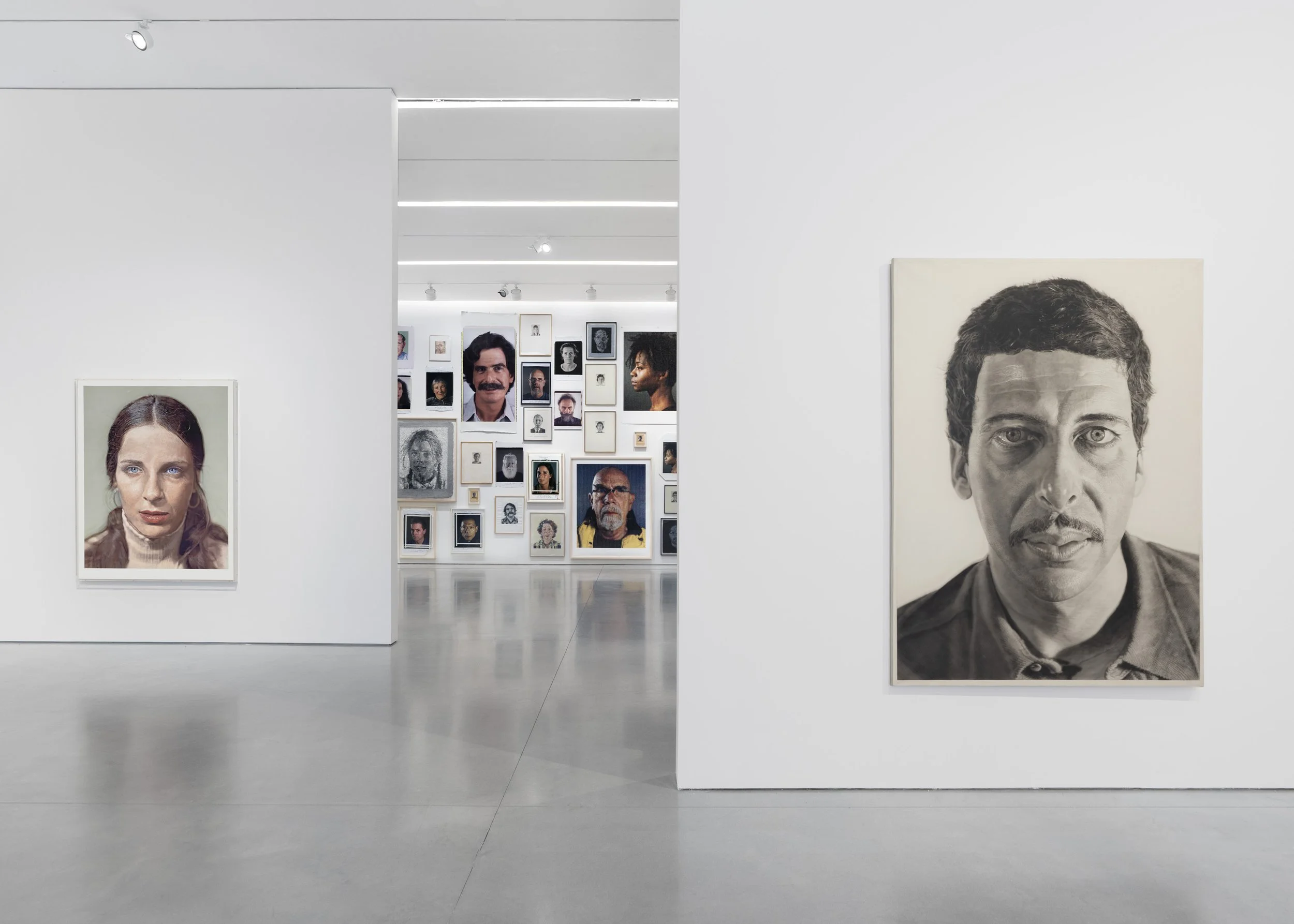
Chuck Close: On Paper
540 West 25th Street, New York, NY 10001 March 12 – April 25, 2026
Photography courtesy Pace Gallery
One of the things that you learn when you lose someone like that at such an early age is that you will be happy again, and that you can survive almost anything. But in terms of that kind of metaphor for a life, falling apart, breaking into pieces, and then the need to restructure it and put it back together, I suppose it's a good analogy for the kind of work that I do, reconstructing an image and then painstakingly putting it back together.
— Chuck Close, on the loss of his father (Chuck Close: A Portrait in Progress, dir. Marion Cajori, 1997)
When you photograph a moving object multiple times in a fast sequence and display the final images one after another at a steady pace, you will have a moving image, a movie. While film creates motion through sequencing, Close produces a different kind of movement within a single, stationary image by reconstructing grains into cells, creating “organic pixels”, which are not perfectly square; they sometimes contain abstract forms within them, each unique and painted in varying colors. You can sense his roots in Abstract Expressionism within each square, but taken as a whole, it is photorealistic.
His process starts with photography, capturing the subject’s appearance at a specific moment in time. This is not an underestimation of photography; on the contrary, it is essential to his process. The photographs do not change over time, at least in terms of the subject’s face, expression, or wrinkles, even though it takes Close months to finish a painting. To him, making a portrait without the photograph would be similar to taking a “mean average,” a flattening of multiple moments rather than committing to a single, fixed image.
The Pace Gallery exhibition includes his photographs displayed with an overlaid grid; each square on the photos is numbered. The translation process begins when Close draws the grid scaled up onto the canvas and starts painting out the squares one by one, revealing how we are able to recognize the person once all parts come together. A constant disassembling of the “reality” and abstracting each and every piece one by one, it becomes a form of performative art embedded in the act of painting.
The display of a painting and a photograph of the same subject reveals two constructions of the same portrait, with the painting ultimately prevailing. By achieving photographic “reality” and extending beyond it, the longer you look at these works, the more it feels as if the person portrayed has just blinked.
Chuck Close joined Pace in 1977, and the gallery has since exhibited each new body of his work, with this exhibition offering a definitive look back at his practice.
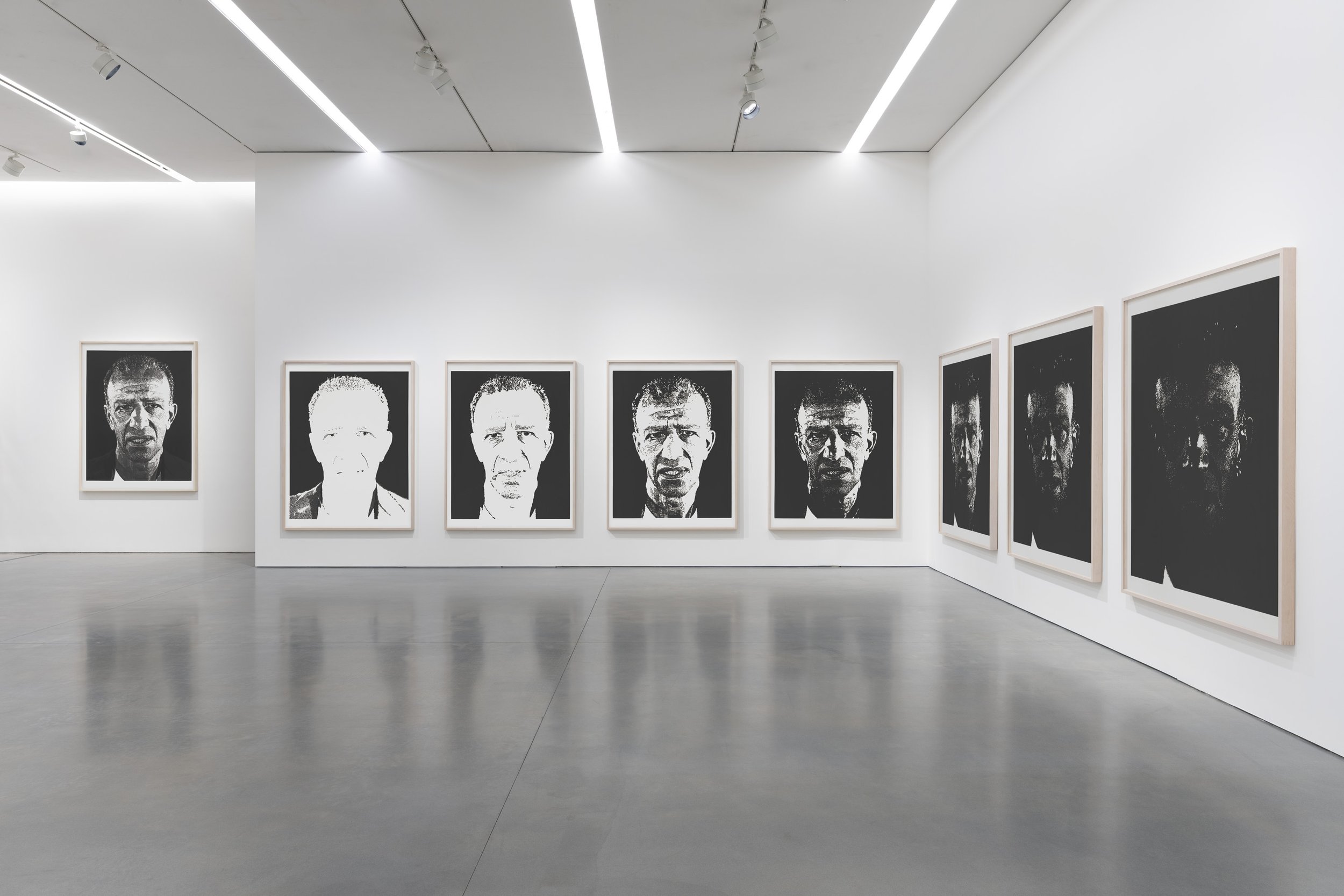
Chuck Close: On Paper
540 West 25th Street, New York, NY 10001 March 12 – April 25, 2026
Photography courtesy Pace Gallery
Review by Burcu Beaufort