The Past Is Our Future
MILANO, DECEMBER 2025
By Burcu Beaufort
Munich born artist, scholar, and university professor Hito Steyerl is not interested in speculating about the future in the way everyone else seems to be. She also appears to have little interest in producing future scenarios built on today’s technological developments, including AI.
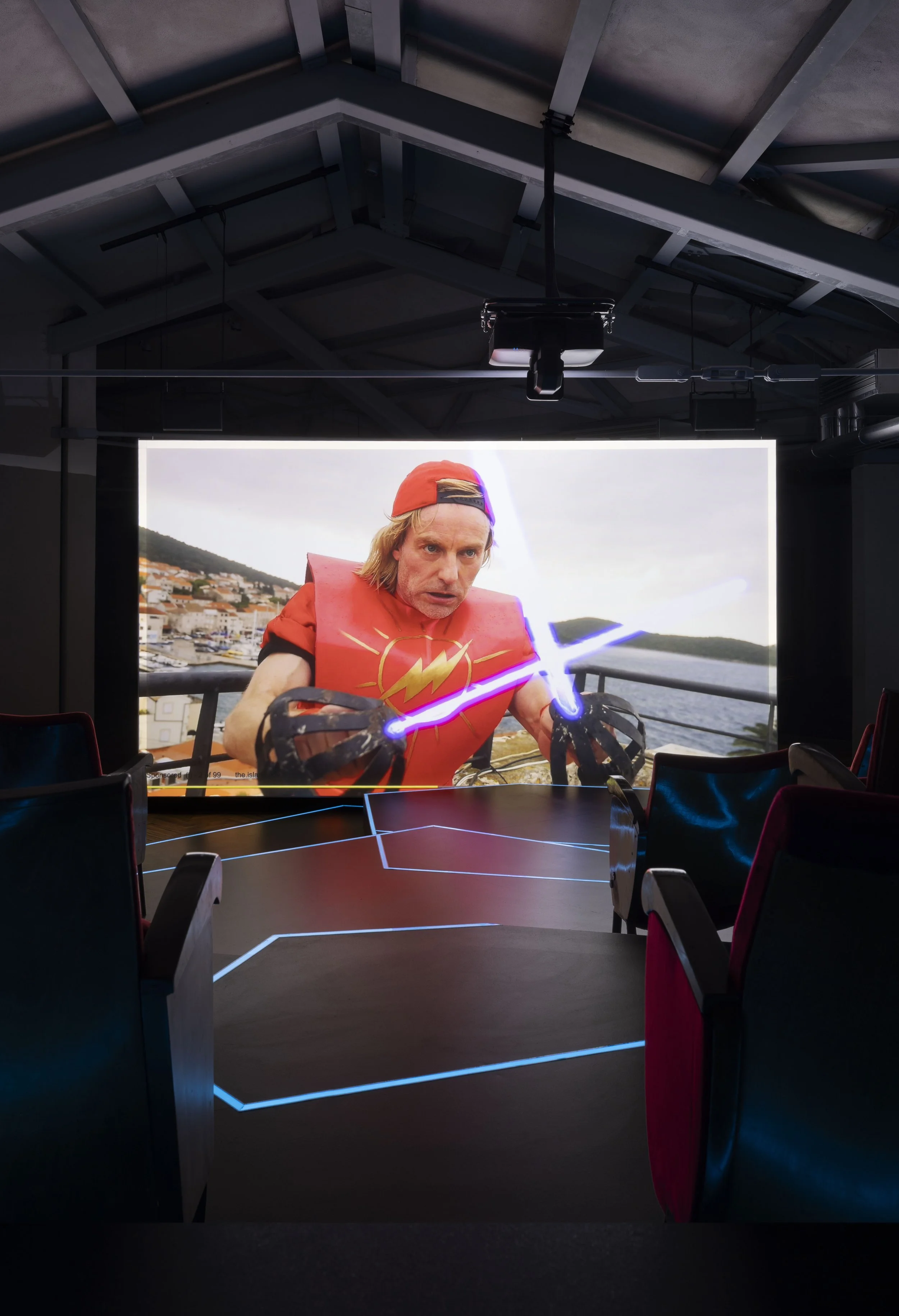
She is instead brave enough to look far into the past. As the main character Flash Gordon in her latest experimental movie The Island puts it, there must be some recipes from the past to save the world, to save our future.
Images by Marta Marinotti with the courtesy of Fondazione Prada
With all her wit and critical sight upon things Steyerl is struck by an anecdote by Darko Suvin, a legendary contributor to science fiction, known for his thorough analysis of the genre. Darko Suvin has been a passionate reader since his early ages, and he had also been watching the period’s action thrillers like Flash Gordon’s Trip to Mars (1938). The black and white movie is not a mere entertainment for him. Instead this is the movie that saved him from falling into the dark realms of endless pessimism as an 11-year-old boy stuck in a tram in Korčula with his parents, all carrying a David Stern upon their chest, as the Nazis were bombing the post office.
Exactly in this moment of “hoping nothing horrible happens” in the tram, he immediately recalls Flash Gordon’s Trip to Mars, the possible futures. As Steyerl explains: “Suvin realized that in any situation, it’s possible to find other worlds, which is the foundation of science fiction: creating parallel worlds even in the most adverse circumstances. I was deeply fascinated by the inventiveness that allowed science fiction to emerge from an extremely critical event. Later, I realized that this concept could be developed visually through quantum technology, because it deals with sudden changes in the state of matter, but also with the coexistence of different states at the same time.”
These possible futures, even in the most adverse situations, form the starting point of her latest installation at Fondazione Prada. Spread over two floors in the Osservatorio within the gorgeous Galleria in the heart of Milan.
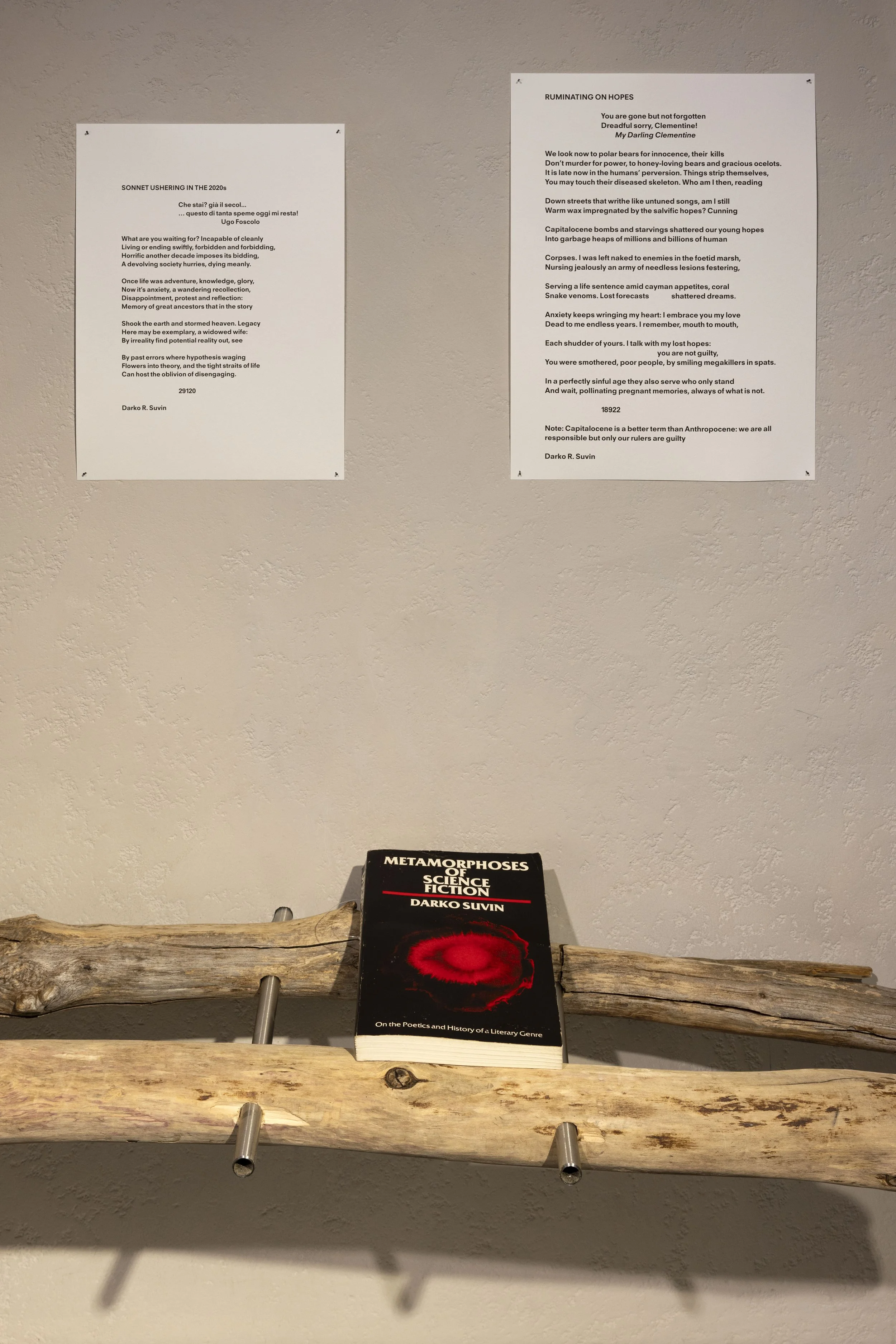
The exhibition opens with Darko Suvin’s two poems and his centuries-spanning book Metamorphoses of Science Fiction. Once a genre offering possible futures, science fiction is now the “poor cousin in the rich family of fantasy,” as Suvin puts it. Seriously, who reads Heinlein anymore, or Ursula K. Le Guin? Who knows PKD beyond the movie adaptations such as Blade Runner (1982) or Minority Report (2002)? Does Frank Herbert’s work get justice if we only experience the Dune saga on the big screen?
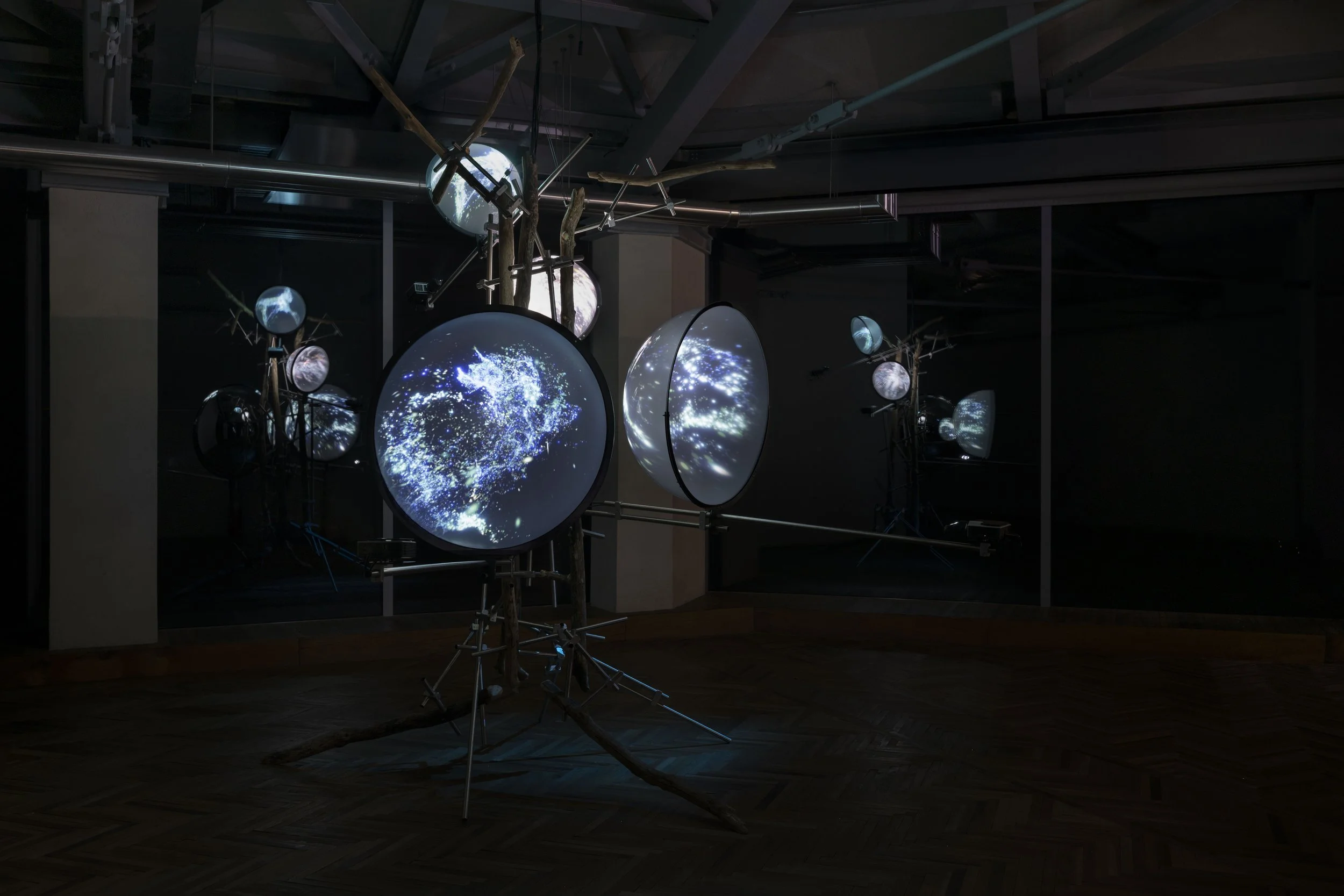
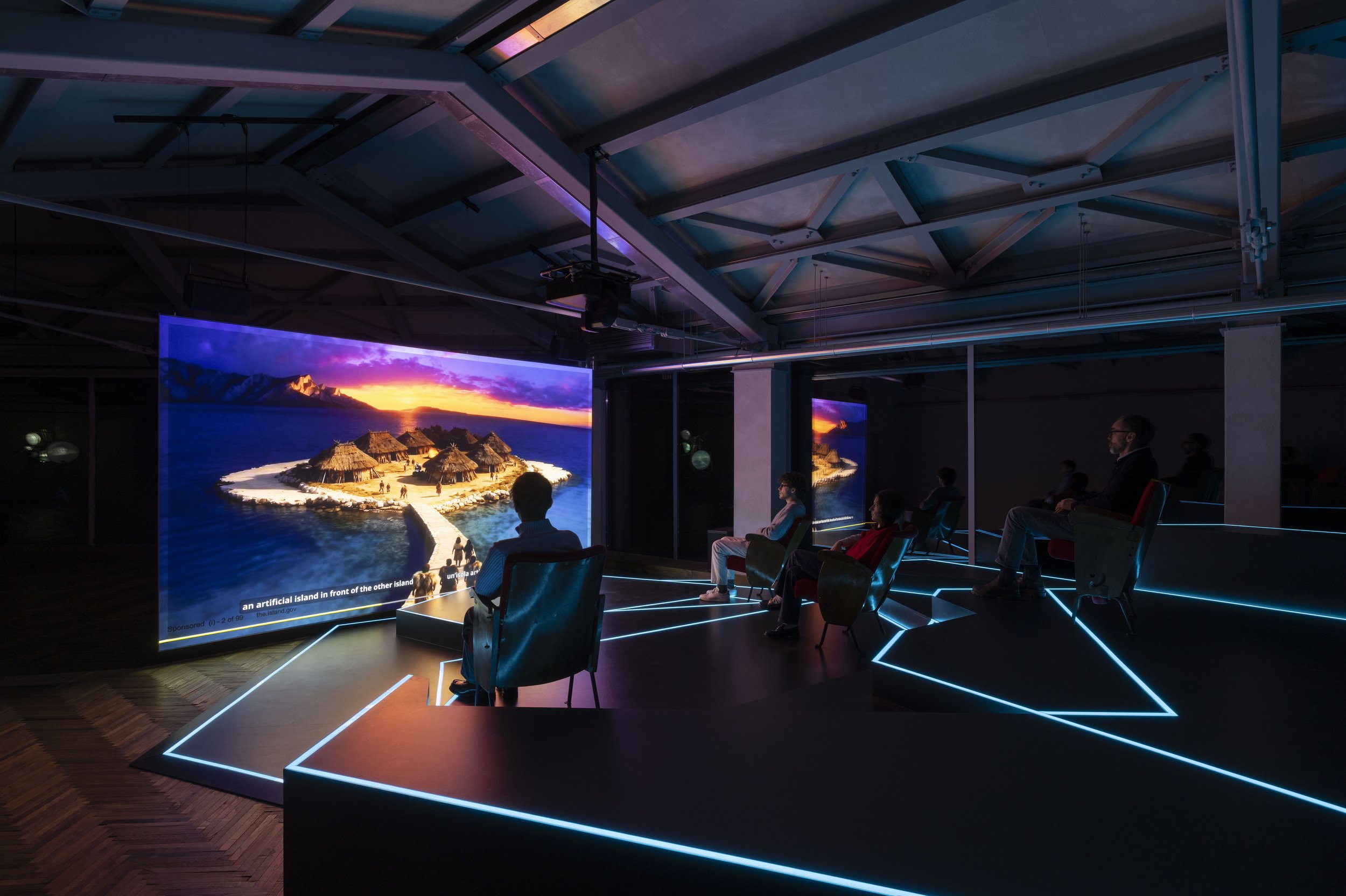
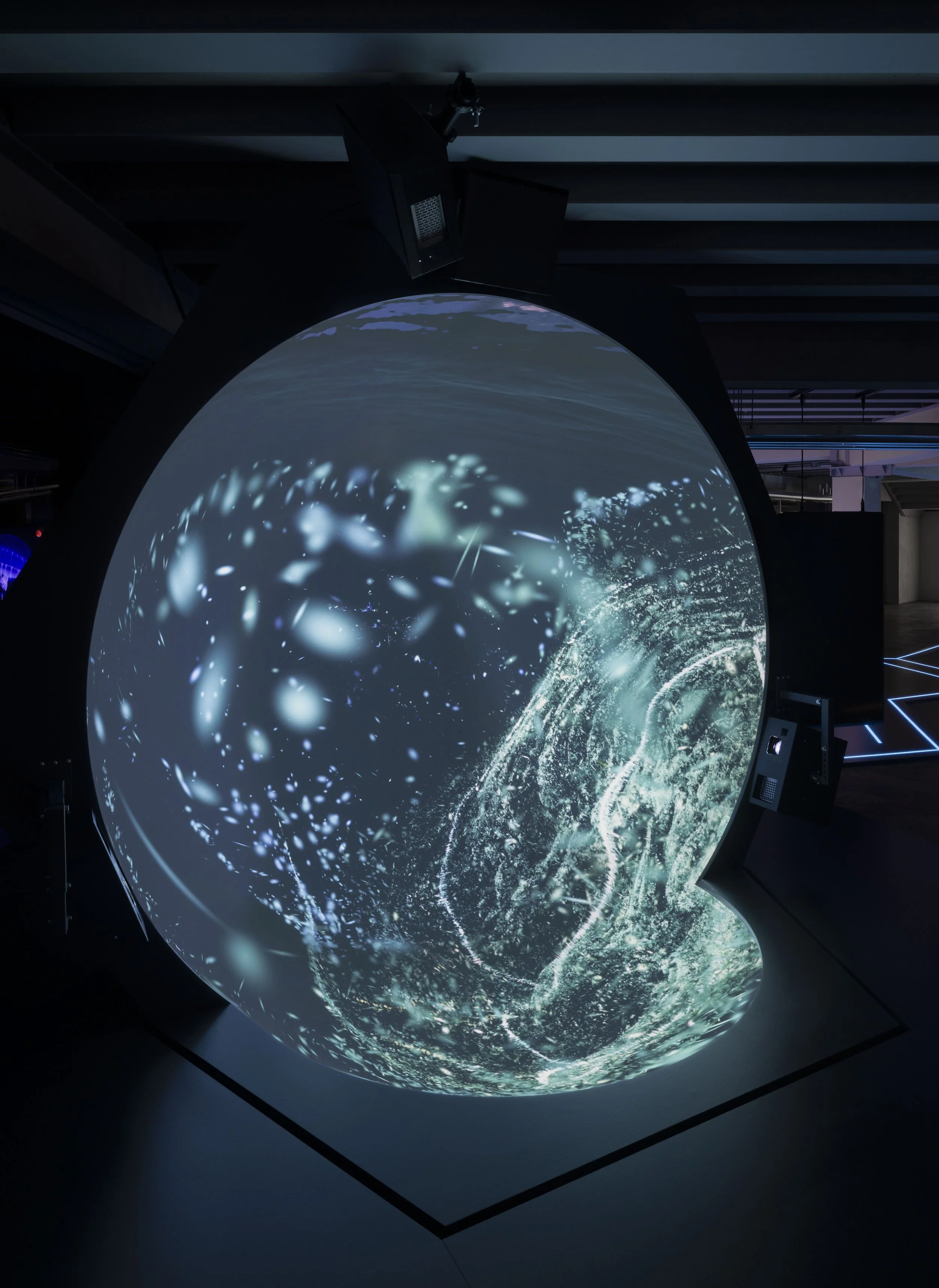
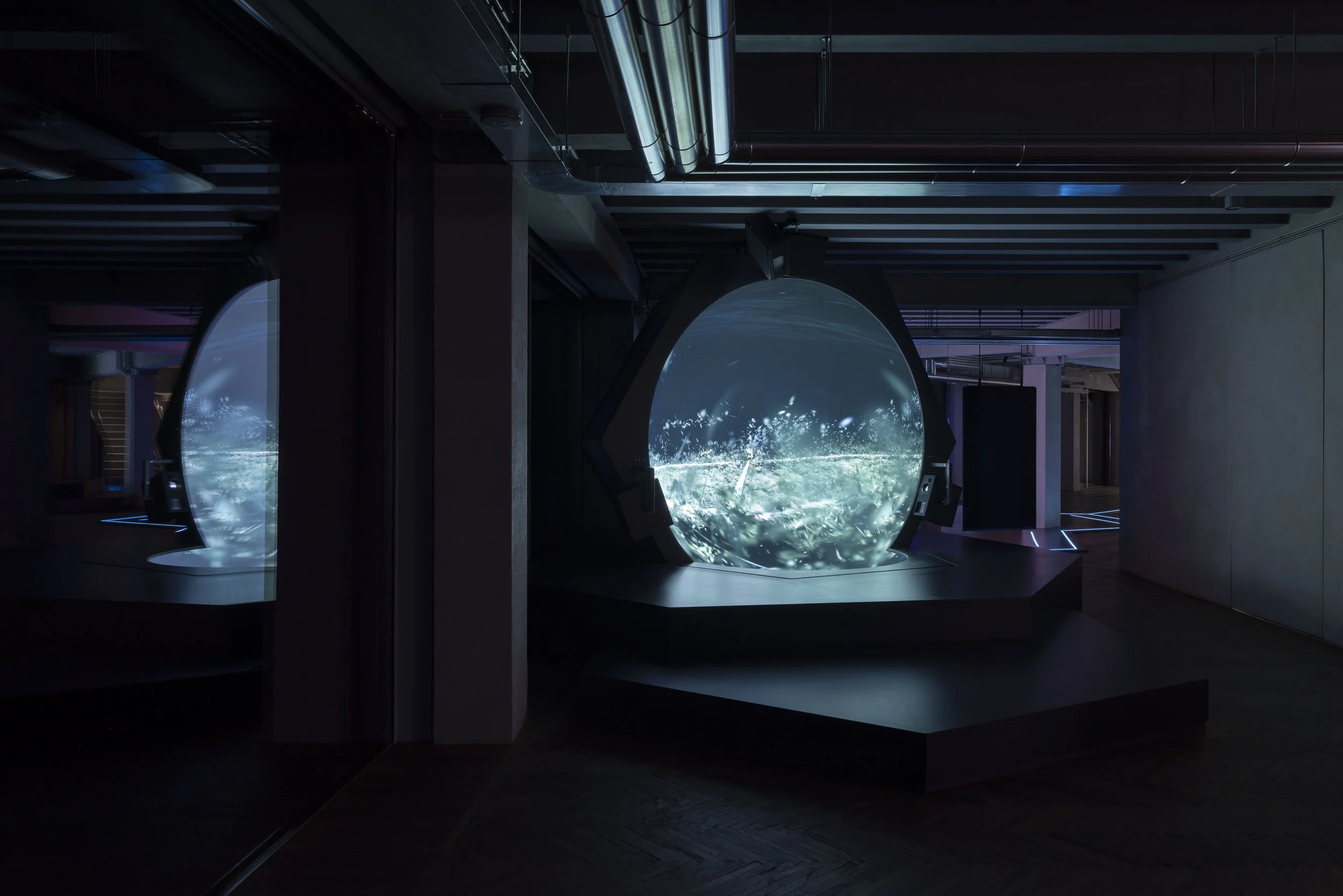
Walking further into the darkened exhibition space in the Osservatorio, two beautiful video projections on half spheres provide an immersive, if not trippy, experience of a submerged artificial island. The island is artificial, but its story is not. These remains are 7,000 years old and were discovered in 2021 by the archaeologist Mate Parica in Dalmatia. Standing in front of the beautifully illuminated underwater projections, the story of the artificial island is linked to bioluminescent plankton, tiny glowing organisms that Shimomura studied to measure wave motion. This work earned him the Nobel Prize in Chemistry in 2008, along with Martin Chalfie and Roger Tsien, for the discovery and development of Green Fluorescent Protein (GFP). References to the organic molecule Luciferin are incorporated into the exhibition and can even be walked upon, as the Fondazione Prada team later explained during dinner. In addition to the light from the video screens, the dark exhibition space is softly illuminated by floor installations shaped like the molecules. As part of the installation, Steyerl also includes an interview with Dr. Sachi Shimomura, the daughter of the Nobel laureate, weaving her reflections and her father’s story, including his survival of the atomic bombing of Nagasaki.
In addition to these three interviews, Steyerl also collaborates with Tommaso Calarco, one of the world’s leading quantum physicists. Tommaso’s explanation of quantum mechanics with the analogies pulled from his choir practices in his own childhood is nothing surprising, and entirely understandable. Later in the evening Steyerl agrees with me as I tell her how similar the scientific and the artistic approach towards the unknown is, both being creative processes only with different tools. She explains how creative her physicist father was, handcrafting his own experiences on atoms with the most simple things from Baumarkt, German hardware stores.
Of course Tommaso’s explanations of the quantum terms such as bits and qubits, superpositions metaphorically aligns with the multiple realities explored in science fiction, a genre which Darko Suvin was and is fond of ever since his childhood. With all these incredibly nurturing and interconnected knowledge bites from the four interviews, we see Steyerl’s short film on the second floor. It is a hilarious and intellectual jump-around between the four narratives, all connected through the hopeful and energetic modern day Flash Gordon, played by German actor Mark Wascke.
The film is neither a nostalgic ode to the past nor an anti-utopian futuristic fiction dominated by an AI nightmare. Steyerl delivers a sharp satire of the “so-called AI,” offering a profound observation of the banalities and ridicule of the current state of things.
In her talk with Niccolò Gravina, she explains “with the emergence of so-called artificial intelligence it is even more crucial to think carefully about what kind of technology to use and how to use it. Authoritarian Al slop is a case in point. It emerges at the junction of increasingly post-democratic rule with extremely monopolized control of so-called Al. The result is an automated, memefied, Midjourney aesthetic. One could call it a Musk-olini style, a sort of ironic transgressive reinterpretation of fascist styles, but in the manner of Italian brainrot, which in itself ironically recalls the genre of futurist aeropittura. It is pre-figured, for example, by the fact that in Dubrovnik all historical tours have been replaced by Game of Thrones location tours. The history of the free republic was exchanged for the history of some fictional oligarch fantasy kitsch, that now proliferates through libertarian ventures such as the Praxis Corporation, which wants to buy up land around the Mediterranean and establish crypto-based private cities. You see, it is not the old aesthetics of reaction, but something of a different order.”
The exhibition is a collaboration between science and art, it requires attention to detail, and it offers a way out of the current flood of junk time, junk information, junk everything using past recipes with the ingredients of intellect, real world interactions and curiosity of human mind.
It will be shown until the end of October 2026, if you plan to visit the city, spare 1-2 hours of diving into Steyerl’s latest universe before it is flooded out by the AI slop.