David Lynch: The Art of Unease
BERLIN, JANUARY 2026
By Burcu Beaufort
“When I first thought of making a film, I heard a wind and then I saw something move, and the sound of the wind was just as important as the moving image - it had to be sound and the picture moving together in time.”
— Room to Dream (2018) by David Lynch and Kristine McKenna
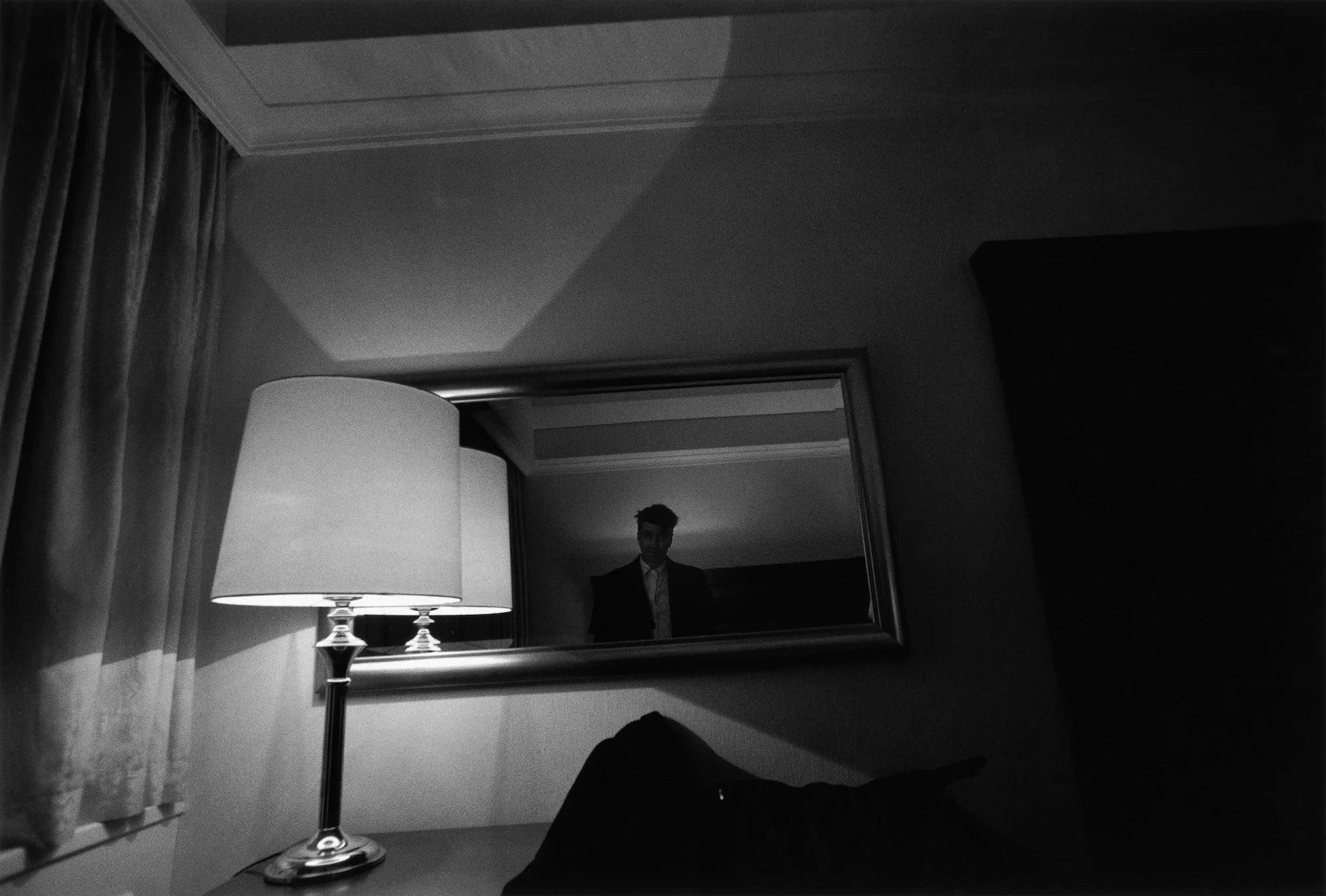
David Lynch, Untitled (Berlin 5364: 21), 1999 © The David Lynch Estate, courtesy of Pace Gallery
Pace Gallery Berlin, which opened in a former gas station with Galerie Judin in May 2025, presents an exhibition offering a focused cross-section of David Lynch’s work. The show features previously unseen mixed-media paintings and watercolors in frames Lynch built, three lamps from his 2022 Pace debut, little-seen black-and-white photographs of Berlin’s industrial landscapes, and a screening of his early film The Alphabet (1967), a four-minute work pivotal to his career.
The exhibition opens with The Alphabet, which had sparked a series of lucky events, leading his way to Hollywood. Starring his then-wife Peggy Reavey, the film was inspired by the story of Reavey’s niece giving an anxious recitation of the alphabet in her sleep. It opens with a shot of Peggy Reavey in a white nightgown on a bed. The soundtrack includes children singing “A-B-C,” Lynch’s friend Robert Chadwick performing a gibberish song, and Peggy reciting the entire alphabet. The final scene shows the woman writhing on the bed and vomiting blood. Lynch describes the short film as “a nightmare about the fear connected with learning.” For The Alphabet, he records a bunch of sounds using an old Uher tape recorder. It turns out that the recorder was broken and the sounds he recorded were all sort of distorted, which he loves even more. On a side note, he brings back the tape recorder and gets his money back, which is a great deal for an art student with almost no money.
Making The Alphabet was made possible by Lynch’s earlier film Six Men Getting Sick (Six Times) (1967), a one-minute animation looped six times, accompanied by the sound of a siren throughout. The film was awarded the Dr. William S. Biddle Cadwalader Memorial Prize, a $250 award for the most experimental piece of sculpture or painting produced during the school year, which Lynch shared with the painter Noel Mahaffey. Besides the prize from the Pennsylvania Academy of the Fine Arts, this piece had impressed a former Academy student, H. Barton Wassermann, so much that he gave Lynch a thousand dollars to make a film installation for his house. The so-called Wassermann Commission unfortunately did not come to life, as Lynch’s Bolex was broken and the images were all blurred. Yet, Lynch was allowed to keep the rest of the funds, and used them for The Alphabet.
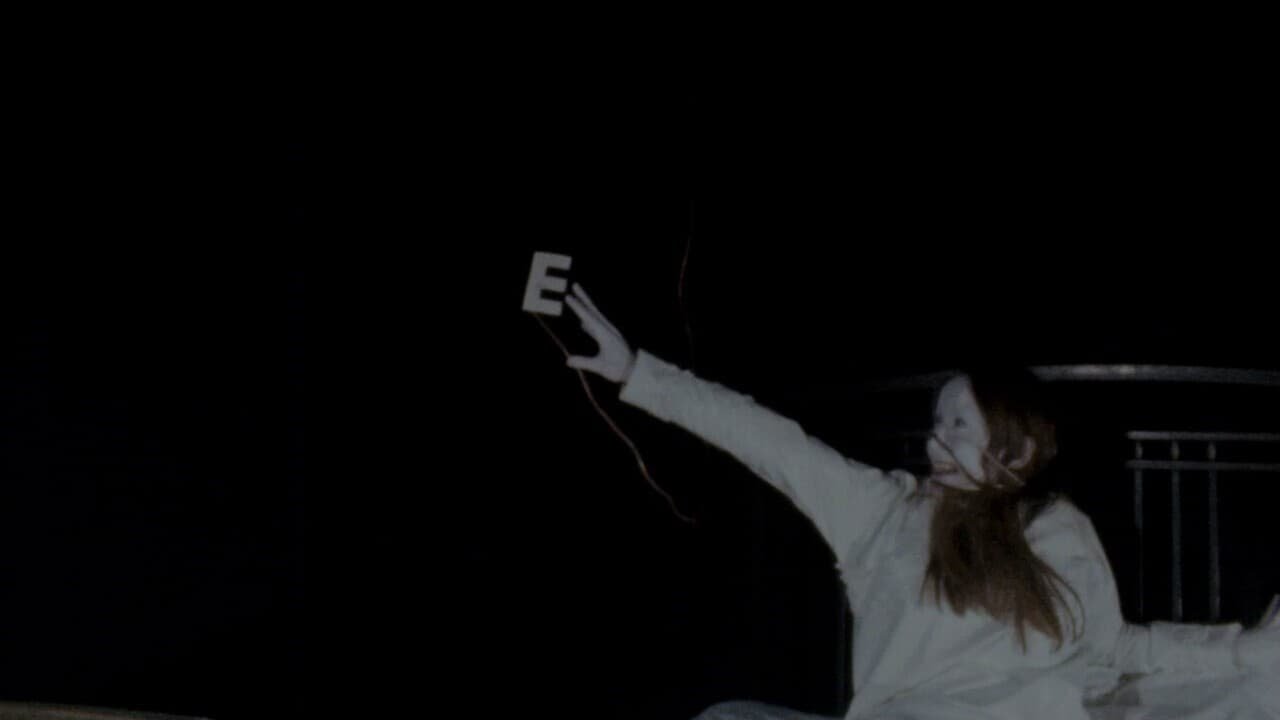
Peggy Reavey in The Alphabet (1969), written, directed and filmed by David Lynch.
After its finalization, Lynch submitted The Alphabet to the American Film Institute (AFI) in order to receive a $7,500 grant to finance his next film The Grandmother. The grant awarded by AFI was in fact only $5,000, but David Lynch managed to receive fifty percent more when Toni Vellani, the then-director of the AFI Conservatory, paid him a visit from Washington, D.C. to Philadelphia and approved his submission. Not only that, Mr. Vellani invited Lynch to the AFI Conservatory (back then Center for Advanced Film Studies) in Los Angeles, California, and the rest is history.
In an interview with Artforum in 2019, David Lynch said, “I don’t really like flat paintings. I like things protruding or also going in. I like organic things and I like both sides of the evolution: the sprouting, the growing, and the blossoming. But I also like the decay, the other side.”
Well, go and see for yourself what he means.
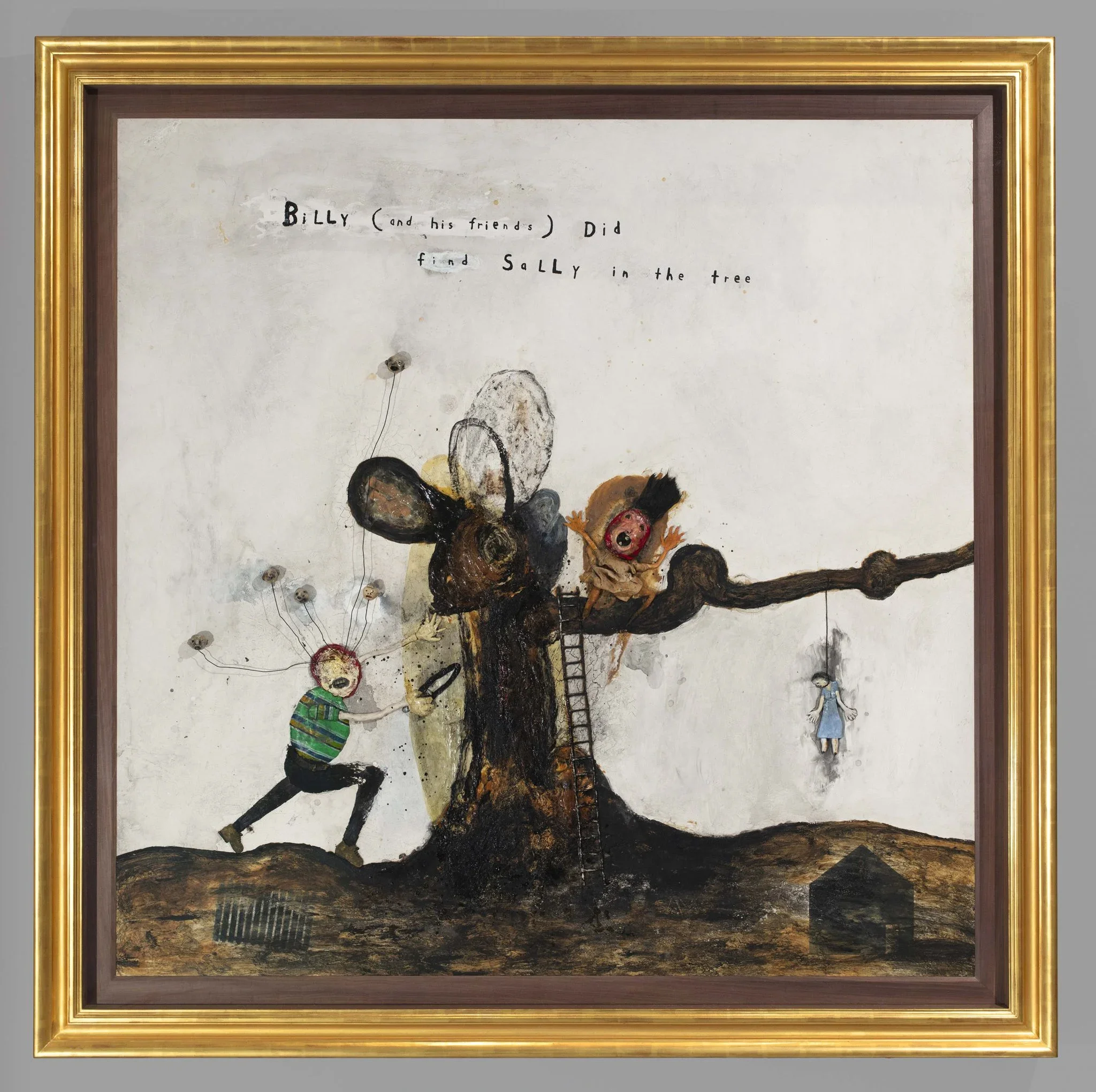
David Lynch, Billy (and His Friends) Did Find Sally in the Tree (2018) © The David Lynch Estate, courtesy Pace Gallery
Lynch’s mixed media paintings incorporate little plaster sculptures glued onto the canvas, as well as metal wires, found objects like pocket knives, wood glue, and sawdust. His drawings are perfectly childish but what comes across through them is definitely not. It is rather a sense of a nightmare, cold wind, and an absolute silence that could be torn apart by a scream – a woman’s scream. On many occasions, he told how Philadelphia, the poor man's New York City as he put it, had a huge influence on his work. He described in the documentary David Lynch: The Art Life (2016) directed by Rick Barnes, Olivia Neergaard-Holm, and Jon Nguyen that “There was a thick fear in the air. There was a feeling of sickness, corruption, and racial hatred. But Philadelphia was just perfect to spark things. [...] Even though I lived in fear, it was thrilling to live the art life in Philadelphia at that time.”
All things uncanny, well, not because the paintings include some elements of violence but because they all have this masterfully pure, childlike crafting which puts all those unsettling ideas right into childhood, to the beginning of a lifetime, so that they are inescapable and simply belong to life, no matter what the surface offers us to look at.
In addition to the mixed media paintings on canvas and on wood panel, there are some of his watercolour works on view at the gallery. You almost want a magnifier to follow each line he made, not out of necessity, but out of curiosity, as if you might discover movements within these lines and observe some sort of microscopic lifeforms. A magnifier could also help to decipher some of the letters or words he uses on those drawings. It is a world to be discovered with great attention and a dream-like state at the same time.
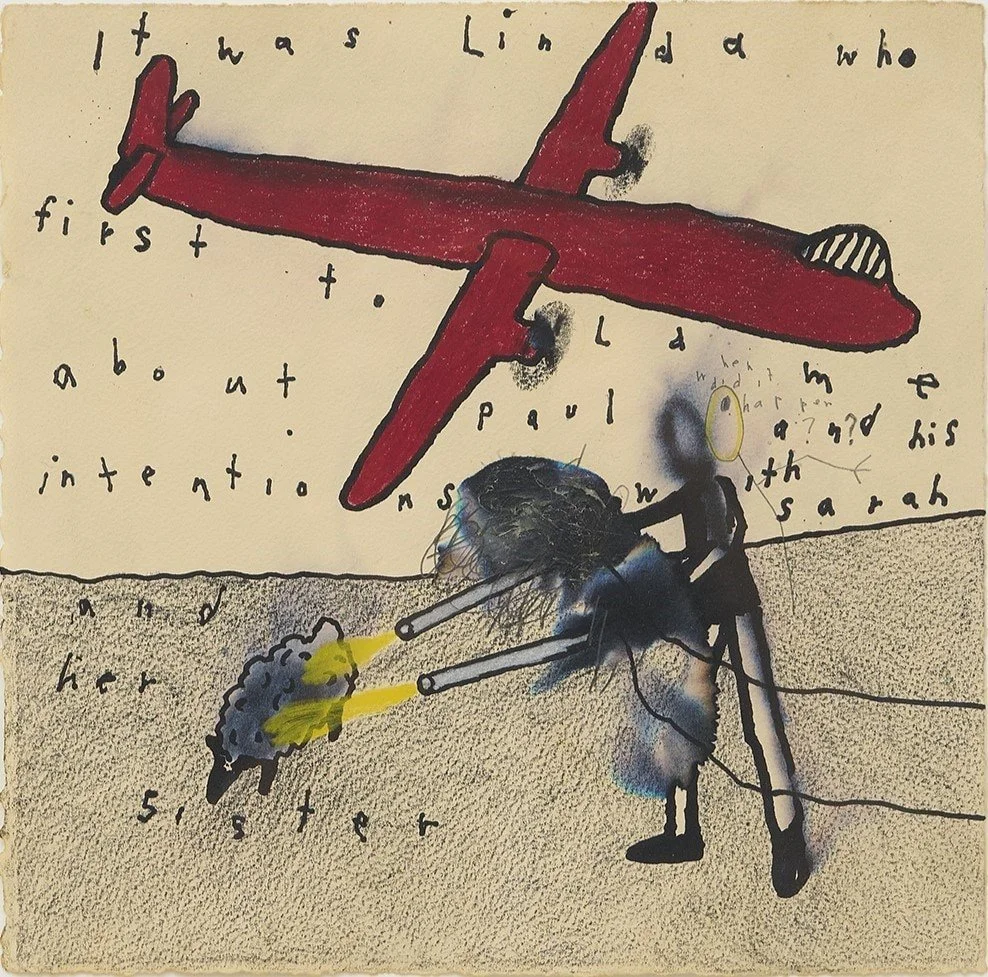
David Lynch, It was Linda who..., 2021© The David Lynch Estate, courtesy of Pace Gallery
Besides his work as a painter, the filmmaker’s handmade lamps, described by Bill Griffin as light sculptures, are also part of the exhibition. The light coming through the amber-toned plexi glass is so moody, I wanted to simply turn off the lights at the gallery and take a moment to dive into that light Lynch construed in a certain tone. I wondered which dream or story he had in mind while adjusting the tiniest details of those artworks. Looking at the Red Zig-Zag (2022), a functional standing lamp by Lynch featuring a perfectly imperfect red resin zig-zag, it is unavoidable to think how much joy he must have had while shaping and painting it in such a rich red. Looking at his lamps, the idea comes to me that Lynch takes Bauhaus and turns it into something organic and utterly mysterious, the signs of his handcraft give his artwork a subtle vibration; again, go and check it out yourself.
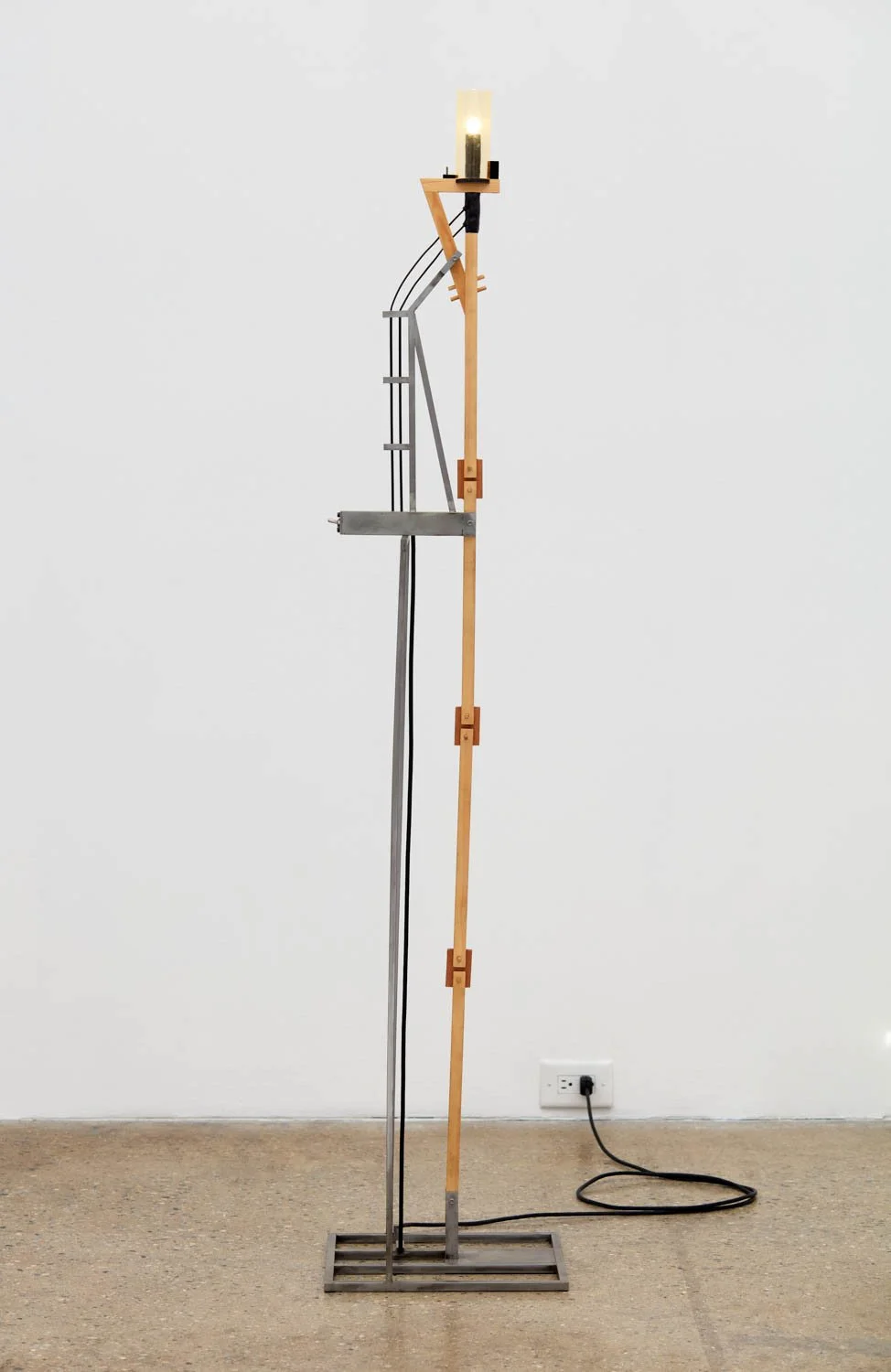
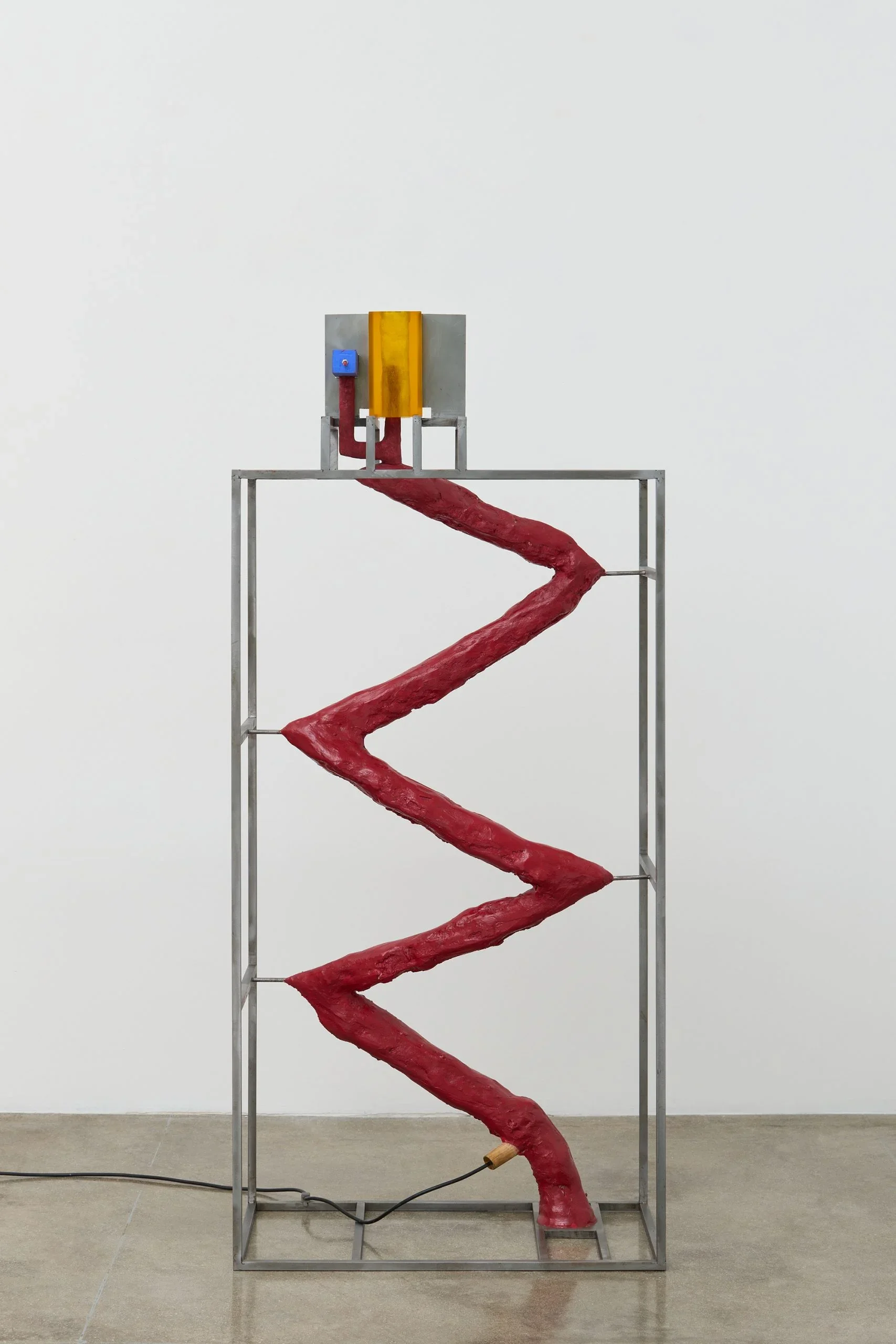
David Lynch, Matchstick Lamp C (2019) and Red Zig-Zag (2022) © The David Lynch Estate, courtesy Pace Gallery
What makes Berlin relevant in this exhibition is the photos he took in this city during his stay in 1999. The abandoned factories, heavy shadows and the old industrial equipment have long been the subjects of his photography out of his love for the smokestack industry. It is not the techniques of photography that are relevant here, although he masters photography, just see his now rare-find book The Factory Photographs (2025) published by Prestel. It is all about the dream he is having through all that steel, concrete, glass, and all kinds of machine parts. All photos are black and white taken with a 35mm film camera, including one selfie in probably a hotel room. It is so charming seeing David looking at himself through a mirror in a room in Berlin somewhere, which feels like a tiny “I was here.” note in his own handwriting.
The exhibition is on view at Pace Gallery, Berlin, until March 29 2026, and then at a larger scale in Los Angeles, September 13–November 7, 2026.
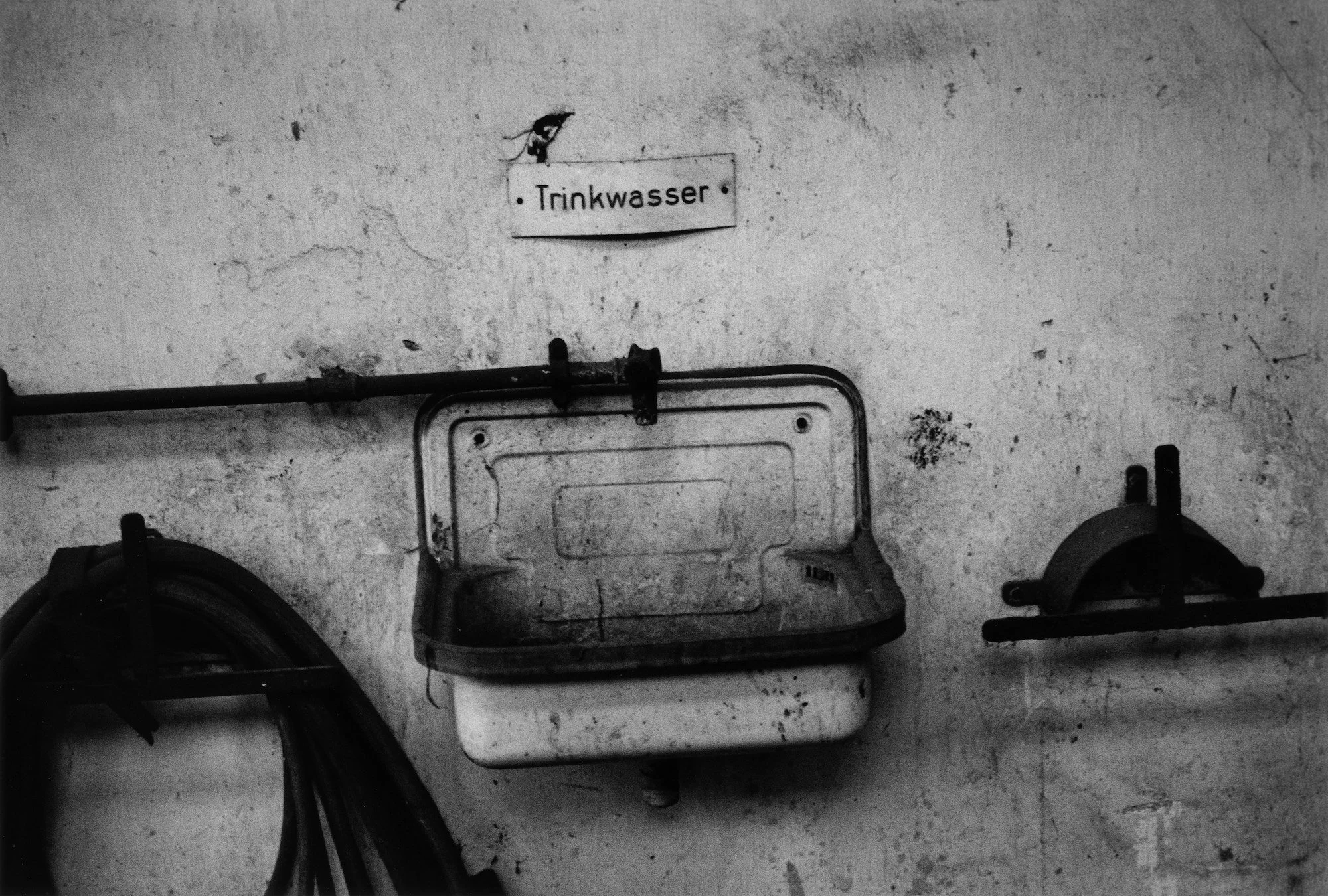
David Lynch, Untitled (Factory, Berlin 5359: 10), 1999 © The David Lynch Estate, courtesy of Pace Gallery