Berlinale 2026 Reviews: Yellow Letters
BERLIN, February 2026
By Burcu Beaufort
Für die deutsche Version nach unten scrollen
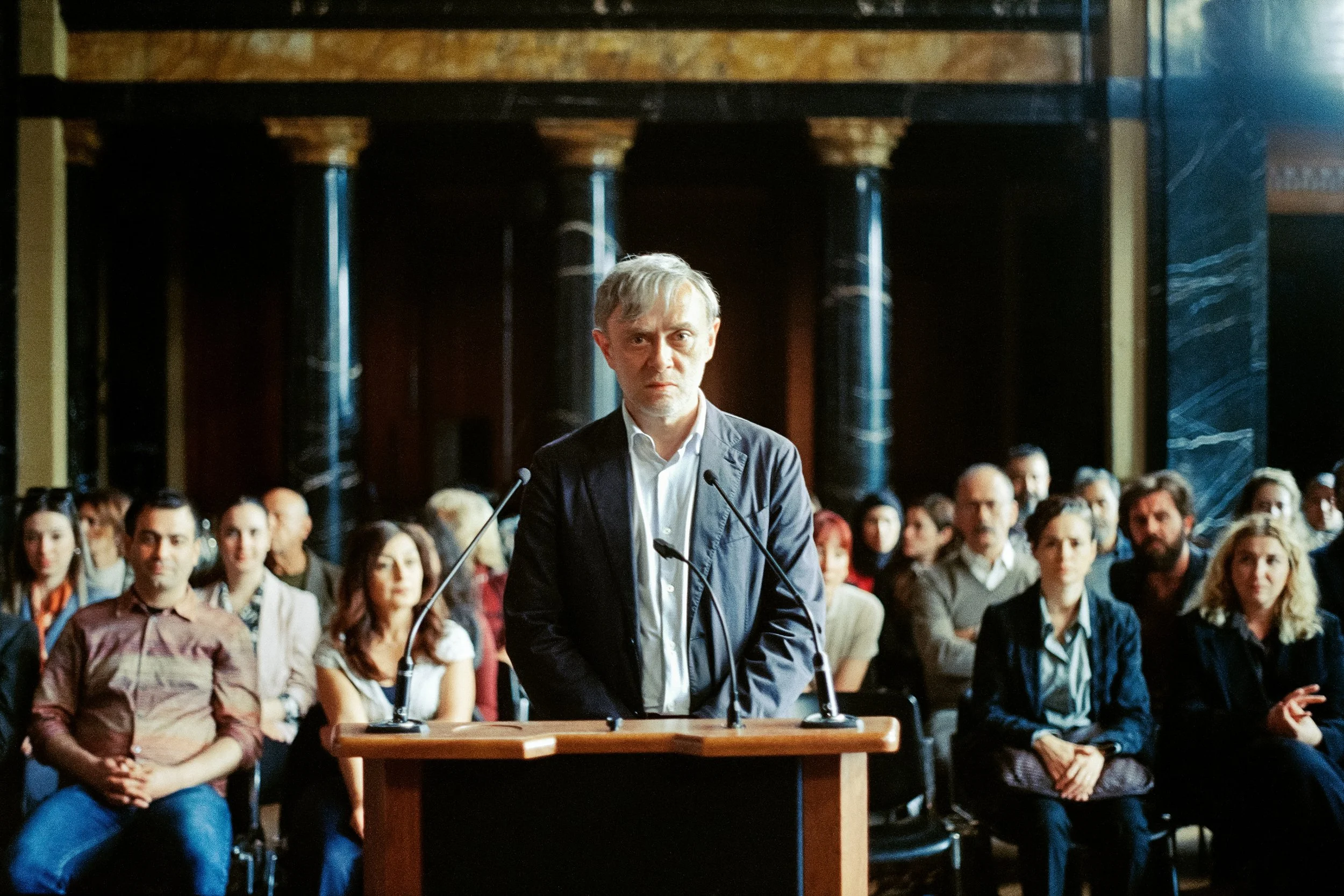
This year’s winner of the Golden Bear at the 76th Berlinale, Yellow Letters (2026) by Oscar-nominated Ilker Çatak is political in subject, yet far from a conventional political thriller, a genre usually inspired by real-life events and told in a way that generates narrative tension.

© Ella Knorz_ifProductions_Alamode Film
Çatak’s latest movie is about an artist couple, a director-actress duo, who are suspended because of their latest theatre play staged in Ankara, Turkey. Upon their suspension, the couple, together with their teenage daughter, decides to move to Istanbul, where both of them have relatives with whom they may not always share the same Weltanschauung. The head-on clash of idealistic dreams against the mundane realities of everyday life, with unavoidable financial struggles, compromises the relationships between the family members, finding its resolution through a falling action in which “there is no right or wrong and both sides are right.” (See Çatak’s statement in the Berlinale press conference)
Çatak may have the right instinct when it comes to pointing out a burning issue of the contemporary moment; however, the focus is lost and drowned in the odd details of everyday life, from how the characters drink their Turkish coffee to how to save money at a Turkish bazaar.


© Ella Knorz_ifProductions_Alamode Film
It is up to the audience to find out which political issue Çatak wants to criticise. Even a politically informed audience is left guessing about what this is all about. Most of the time, the film criticizes a “system,” which is hard to grasp. What is meant to resemble a Kafkaesque structure of control never achieves that level of sophistication; it appears hazy, loosely defined, and conceptually underexamined.
Besides well-known actors from Turkey, Çatak chooses to “cast” Berlin as Ankara and Hamburg as Istanbul. During the Berlinale, he explained that the reason behind this decision was to give this “political issue” a global stage rather than leaving it as a “local problem.” It is questionable why a political issue would remain merely “local” when shot in Turkey, and how it would suddenly become “globally relevant” when relocated to Germany.
The director may see parallels between today’s rising autocracy and Germany in 1933, yet this abstraction pulls the story from its political reality, turning it into a heavy-handed fairy tale in green Berlin and missing the chance for a singular political thriller in the greyness of Ankara.
Despite the drawbacks of casting “cities” and an overly talkative script, Yellow Letters delivers powerful cinematography by the master Judith Kaufmann and strong performances by both Özgü Namal and Tansu Biçer.
The movie is planned to be released in Germany in early March.
DEUTSCHE VERSION
Der Gewinner des Goldenen Bären der 76. Berlinale, Yellow Letters (2026) von dem Oscar-nominierten İlker Çatak, ist thematisch politisch, jedoch weit entfernt von einem konventionellen politischen Thriller – einem Genre, das normalerweise von realen Ereignissen inspiriert ist und auf eine Weise erzählt wird, die narrative Spannung erzeugt.
Çataks neuester Film handelt von einem Künstlerpaar, einem Regisseur-Schauspieler-Duo, das aufgrund ihres letzten Theaterstücks in Ankara, Türkei, suspendiert wird. Nach ihrer Suspendierung beschließt das Paar zusammen mit ihrer jugendlichen Tochter, nach Istanbul zu ziehen, wo beide Verwandte haben, mit denen sie nicht immer die gleiche Weltanschauung teilen. Der direkte Zusammenprall idealistischer Träume mit den alltäglichen Realitäten des Lebens, verbunden mit unvermeidlichen finanziellen Schwierigkeiten, belastet die Beziehungen innerhalb der Familie und findet seine Lösung in einer Fallhandlung („falling action“), in der „es weder richtig noch falsch gibt und beide Seiten recht haben“ (siehe Çataks Aussage auf der Berlinale-Pressekonferenz).
Çatak mag das richtige Gespür dafür haben, ein brennendes aktuelles Thema aufzuzeigen; jedoch geht der Fokus verloren und ertrinkt in den skurrilen Details des Alltags, von der Art, wie die Figuren ihren türkischen Kaffee trinken, bis hin dazu, wie man auf einem türkischen Basar Geld spart.
Es liegt am Publikum, herauszufinden, welches politische Thema Çatak kritisieren möchte. Selbst politisch informierte Zuschauer bleiben oft ratlos. Meistens kritisiert der Film ein „System“, das schwer zu fassen ist. Das, was eine kafkaeske Kontrollstruktur darstellen soll, erreicht nie dieses Maß an Raffinesse; es wirkt vage, unklar definiert und konzeptionell unzureichend untersucht.
Neben bekannten Schauspielern aus der Türkei wählt Çatak, Berlin als Ankara und Hamburg als Istanbul „zu besetzen“. Auf der Berlinale erklärte er, dass der Grund für diese Entscheidung darin lag, dieses „politische Thema“ auf eine globale Bühne zu bringen, anstatt es als „lokales Problem“ zu belassen. Es ist fraglich, warum ein politisches Thema, wenn es in der Türkei gedreht wird, lediglich „lokal“ bleiben sollte und wie es plötzlich „global relevant“ werden könnte, wenn es nach Deutschland verlegt wird.
Der Regisseur mag Parallelen zwischen dem heutigen aufstrebenden Autoritarismus und Deutschland 1933 sehen; doch diese Abstraktion entfernt die Geschichte von ihrer politischen Realität, verwandelt sie in ein schwerfälliges Märchen im grünen Berlin und verpasst die Chance, einen einzigartigen politischen Thriller in der grauen Atmosphäre von Ankara zu schaffen.
Trotz der Nachteile durch die „Städtebesetzung“ und ein übermäßig gesprächiges Drehbuch liefert Yellow Letters eine kraftvolle Kinematografie von Judith Kaufmann und starke Leistungen von Özgü Namal und Tansu Biçer.
Ab dem 5. März startet Yellow Letters in den Kinos und ist bundesweit für das Publikum verfügbar.