With OLIVER LAXE
CANNES, MAY 2025
Winner of the Prix du Jury at Cannes this year, Sirât plays like Mad Max on a pilgrimage. It is a road movie reimagined not as an escape, but as a spiritual journey through the deserts of Africa. Between dust clouds and roaring engines, the beats are heavy, raw, and unmistakably Berlin. What begins as a party becomes a ritual. Like a club night that stretches beyond hedonism, the film invites us not just to dance, but to transcend, to shed the mask, confront the self, and connect with something greater. The desert becomes sacred ground, the rave a form of worship.
The soundtrack, composed by Berlin based Kangding Ray is more than a score; it’s the film’s pulse. Honored with the Cannes Soundtrack Prize, it’s already a testament to how deeply the sonic architecture shapes the film’s emotional intensity.
The cast, with the exception of the acclaimed Spanish actor Sergi López, consists entirely of real-life ravers rather than professional actors. Their performances bring a lived-in authenticity so that each character feels inhabited, not merely portrayed. López, as the father searching for his daughter, is magnetic. His transformation over the course of the film is subtle, yet deeply affecting.
An ode to early Mad Max and the other road movies of the ’70s, Sirât takes the genre to new heights, or rather, new depths. It’s a trance, a reckoning, a prayer set to beat.
I had the chance to talk to Oliver Laxe just after the premiere. What follows is our conversation.
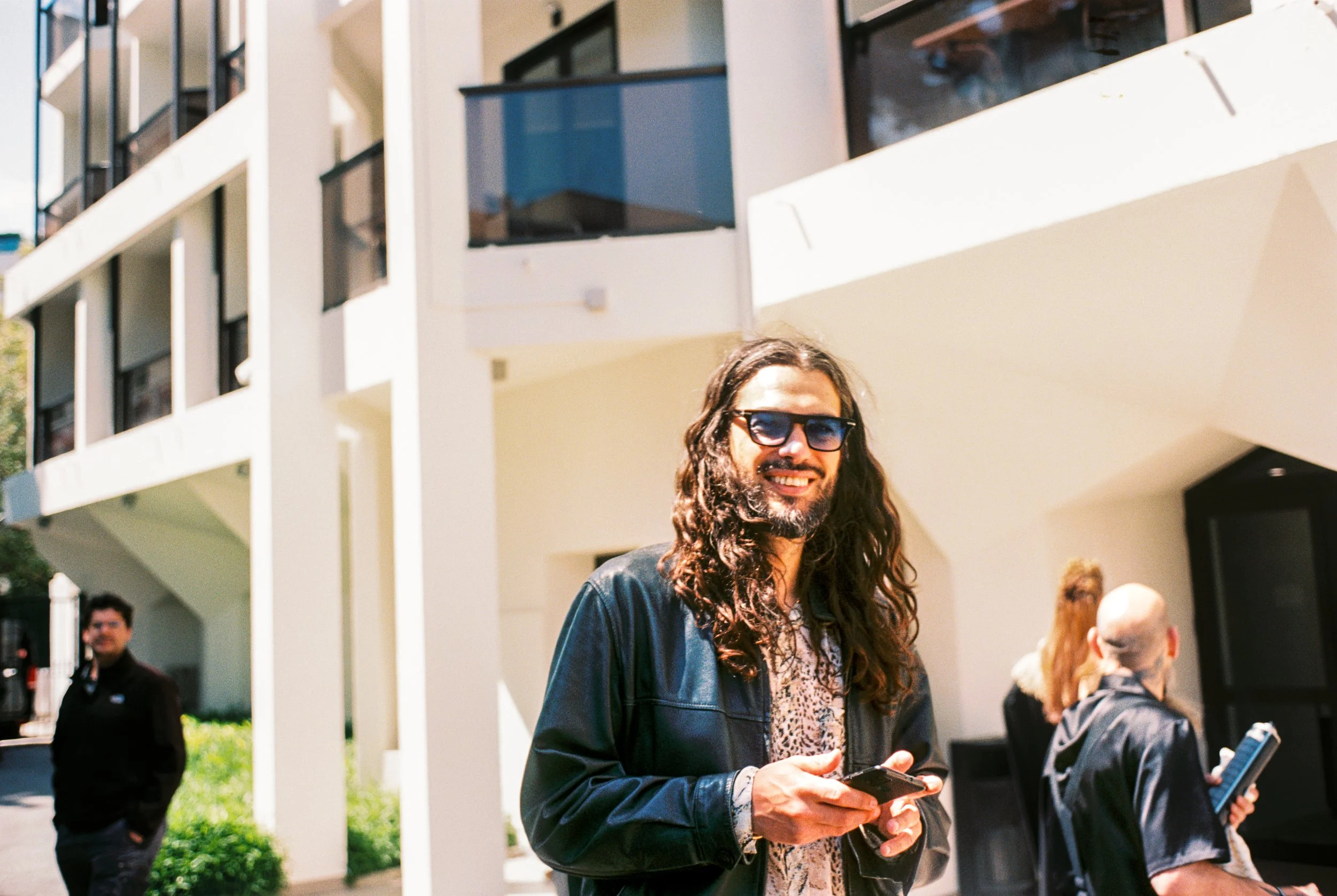
Oliver Laxe Portrait by Burcu Beaufort.
Burcu Beaufort: How do you feel about the film’s reception after its premiere?
Oliver Laxe: I know the film is strong, it’s heavy. I mean, I know I’m inviting the spectator to look inside, and it’s heavy sometimes to look inside, you know? I was afraid before the screening that people would think I’m having a kind of sadistic relationship with the spectator. That was my main fear. Because it’s the opposite, I really want to take care of the spectators. Now I’m better about it, but the days before the screening, I was tense with this.
BB: Making this movie, was it a way to look into yourself as well?
OL: Yeah, as human beings, we always create an idealized image ourselves, as a defense mechanism, to avoid our scars and our wounds. What I try to be is honest.
All my creative processes are related to that process of self-discovery. There are challenges. I was shooting on fires, pushing myself to the limits. And I’m portraying people or realities that, in a way, secretly talk about me. But I discover this only at the end. Making this film allowed me to be more with my scars, with my wounds.
BB: You said the same at the press conference, but what are your wounds?
OL: We’d need more time to talk deeply. I mean… all of us, we have wounds. Even birth is traumatic. As children, we build a mask in order to receive love. And that mask, that’s what we call persona, a character. The problem is as you are growing up, you’re still using this mask. So, my films are always about how to connect with your essence which is covered by personality, the mask, the ego. Crisis is the best way to break this membrane and contact your true self. Therefore ¡Viva las crisis!
BB: The music obviously plays a huge role in your movie, not only for the sake of entertainment but giving the story intensity and depth. How was your approach to that?
OL: I like genre cinema, especially this kind of “anti-genre.” Like the adventure tale. Because every physical adventure always entails a metaphysical one. Like the Grail quests, the Arthurian tales, they all carry that tradition. The exterior epic allows me to propose an interior epic. The challenge is in balancing the symbolism, in making it subtle, not excessive, and more than just abstract ideas. What we want is to propose an experience. We want the spectator to feel it, not just understand it.
BB: I read you said this is your most radical tale. What do you mean by that?
OL: I’m proud of the gesture of the film, its radicality. Radicality comes from the Latin radicalis, meaning “root.” To be a radical is to jump into the abyss and try to connect with yourself, even if you think there’s no safety net. But having faith is about believing that there always is a net that will even transcend you.
BB: Do you think the ravers are radical? Making the film, what did you learn about them?
OL: I learned that I’m a raver (laughs). At first, I felt a bit like an outsider, I just felt admiration. But I realised that I share certain things with them. Like I don’t believe in the Myth of Progress, either. I mean, I’m a child of the Lumières, but I see the limits. We have to accept the imperfection of being human, without dramatizing. In Western societies, we really think as if we’re balanced people. We’re feeding that illusion all the time and escaping ourselves. We are hiding ourselves from growing. When life really shakes us, when chaos arrives, we’re unprepared.
BB: These ravers, they seem to be playing themselves. Are they real?
OL: Yes, we went to raves for casting. We didn’t look for actors, we looked for truth. We wanted each person to represent a kind of archetype — the pirate, the freak, the hippie, the punk. They are really connected to their scars and are often more humble. As Rumi says, broken hearts are the most beautiful because light can pass through the cracks. Also in cinema, I think, as spectators, we like to see fragile people.
BB: Yes, we like to see fragility on the screen. It felt like the movie partly shows how these ravers are discriminated. We see soldiers stopping their parties, the shepherd in the desert runs away from them. They’re a community within themselves, not part of “normal” society.
OL: Yeah. They’re waiting for the end, they are preparing for it. It’s like a kind of medievalism, subtle, more an intuition. For centuries, we lived under skies full of myths. This secular, desacralized world has not a long history, kind of “new”. So there is an echo on us coming from those myths. And these people in the film, they give themselves over to something like dancing, surrender, it’s not irrational. It’s very human.